Trade Show Booth Ideas That Actually Stop People
A mentalist's view of trade show booth ideas: what stops traffic on a busy aisle, what a 20x20 really costs, and when a live act is the wrong answer.
8 min read
- Featured on Netflix
- Ranked 7th in the world in mentalism
- Shows and keynotes for companies
On this page
You have a stand at a show in three months, a budget that already feels tight, and a folder of screenshots of gorgeous booths that all cost more than your marketing quarter. Sound about right?
I have spent a lot of hours standing inside 3x3 metre stands, watching the aisle. Not designing them. Working them. My job at a trade show is to stop a person who has already decided not to stop, hold them for a few minutes, and hand them to your sales team warm instead of cold. That gives me a slightly odd vantage point on booth ideas, because I see which ones work from the inside, standing on the carpet at hour six of day two.
So this is not a gallery. It is what I have noticed about why some booths hum and some sit there looking expensive.
What are some cool ideas for a trade show booth?
Here is the uncomfortable part. Almost every idea works, and almost none of them work by themselves.
The mechanism you are looking for is simple: give a passing human a reason to break stride, and then a reason to stay. Most booths solve the first half and forget the second. A five metre LED wall breaks stride beautifully. Then the visitor stands there, watches a loop of your product rendering, feels vaguely observed, and walks on.
Ideas I have watched perform well, in rough order of how little they cost:
- One question, huge, at eye level. Not your tagline. A question your ideal buyer cannot answer confidently. People stop to argue with a wall.
- A physical thing to do with hands. A lever, a sample, a puzzle, a piece of your hardware they can pick up. Hands committed means feet stopped.
- A scheduled moment. Something that happens at :15 and :45, announced on the wall. Scarcity of time does more than scarcity of stock.
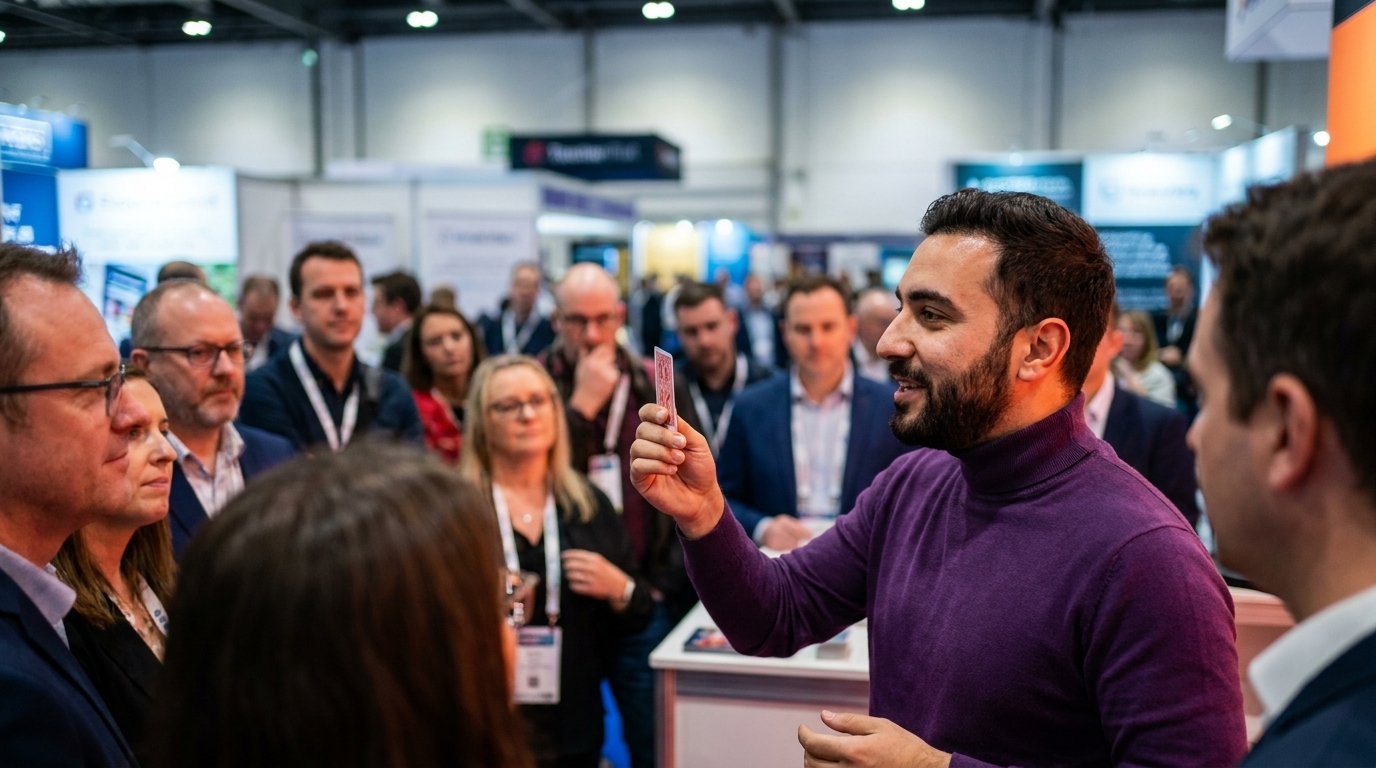
- A live act, human and short. That is my corner. A performer who can gather twelve people and hold them for six minutes turns your aisle frontage into a small theatre.
- Radical emptiness. A stand with almost nothing in it, one object, one person, good light. On a floor where everyone is shouting, quiet is a pattern break. (I have seen this fail badly when the one person on the stand is scrolling their phone. The idea only survives with disciplined staff.)
What I do not see working: bowls of branded pens, a raffle for an iPad, and a screen playing a three minute corporate film. Those pull traffic that has no relationship to your product. You will end the day with a fishbowl of business cards from people who wanted a chance at a tablet, and your sales team will spend two weeks discovering that.
What makes a good trade show booth?
I think about a booth in the same order I think about a show, using the framework I teach as קופס״א: attention, certainty, wonder, story, belief. Translated to a stand it looks like this.
Attention is the first two seconds and it is fought in peripheral vision. A person walking a busy aisle is scanning at roughly walking pace with their head mostly forward. Whatever your message is, it lives on a band between about 1.5 and 2.5 metres off the floor, because below that it is blocked by bodies and above that nobody is looking. Anything written at hip height is written for the cleaning crew.
Certainty is the visitor knowing, instantly, what will happen to them if they step in. Will they be pounced on? Is this a demo? Do they have to give an email? Uncertainty is the single biggest reason people drift past a stand they were interested in. Reduce it. Say what happens. "Two minute demo, no form."
Wonder is the part I am hired for, but it does not require a performer. Wonder is any moment where the visitor''s prediction fails. Your product doing something they assumed impossible counts. So does a well built optical trick on a wall panel.
Story is the shape of the four minutes. Beginning, tension, resolution, and a clean handoff to a human. Most booths have no shape at all, just a surface a person bounces off.
Belief is what the visitor carries out. Not "nice stand". Something closer to "these people understand my problem".
A good booth is one where I can stand anywhere in it and see, physically, where a crowd will form and where the sales conversations will happen. If those two zones are the same square metre, the booth will choke. You need a stopping zone at the front and a talking zone deeper in, and a path between them that does not require squeezing past a graphic panel.
How much does a 20x20 trade show booth cost?
I am going to be straight with you: I do not sell exhibits, and I am not going to quote you numbers I do not stand behind. What I can tell you is the shape of the spend, because I see the invoices clients grumble about while I am eating a sandwich behind their stand.
A 20x20 island is not one cost. It is: design, build or rental, shipping both ways, drayage (the show''s own charge for moving your crates from the dock to your space, which surprises first timers every single time), electrical, rigging if you hang anything overhead, carpet, internet, labour to install and dismantle at union rates where those apply, storage between shows, and then the human costs, flights, hotels, per diems.
The pattern I see is that the physical structure is rarely the biggest line once everything is counted, and rental almost always beats purchase until you are doing three or four shows a year with the same footprint.
The line that gets cut first, and should get cut last, is anything that generates and manages traffic. A magnificent 20x20 staffed by three tired people who did not rehearse their opening line is the most expensive quiet room at the show.
What are some effective booth designs for trade shows?
Design decisions I would defend in an argument:
- Open two or three sides. Every wall you build is a wall people cannot walk through.
- Sightlines through, not into. A visitor should be able to see activity happening inside your space from an angle, before they commit.
- Overhead identification. A hanging sign or tall element is how people find you again after they walked past you at 10am and decided to come back. If you have ever tried to find a stand you liked on a hall of 400, you know.
- Somewhere to lean. Not chairs, which trap your staff sitting down. High tables. People talk longer standing at a surface than standing in open air.
- Light your faces, not just your logo. Hall lighting is grey and flat and makes everyone look like they are waiting for test results.
When is a booth act the wrong answer?
Do not hire me if your goal is fifteen deep technical conversations with named accounts you have already booked. In that case a crowd is your enemy. I will fill your stand with interested strangers and your key meeting will get elbowed.
Do not hire me if your stand is a 3x2 with one staff member. The crowd I gather will not physically fit, and I will be blocking your neighbour''s aisle, which is a genuinely miserable way to spend two days.
And do not hire me to be the reason people remember the show. If the visitor walks away remembering only the guy who knew their PIN and not what your company does, I have failed and taken your money doing it. The act has to be built around your message or it is expensive decoration.
Where a booth act earns its keep is the opposite situation: a big footprint, a sales team with capacity, a product that is hard to explain in a sentence, and a hall where you are one of many similar logos.
So what do you actually decide now?
Before you look at another booth photograph, answer this: at your last show, how many people stopped, and how many of those stopped for a reason connected to what you sell?
If you do not know, that is the first thing worth fixing, and it costs nothing but a clicker and someone willing to count. If you do know and the second number is small, your problem is not the structure. No amount of fabric will solve it.
Decide which of the two you are fixing at this show. Trying to fix both at once, three months out, is how stands end up beautiful and empty.

Who writes here
Neta Bresler, mentalist and perception researcher. Ranked 7th in the world in mentalism, featured on Netflix, performing and speaking for companies and conferences in Israel and abroad. Everything here comes from the stage, not the library.
More about Neta