Hiring a Trade Show Presenter: The Honest Version
What a trade show presenter actually does at a booth, how to brief one, when a presenter is the wrong hire, and the questions worth asking before you book.
7 min read
- Featured on Netflix
- Ranked 7th in the world in mentalism
- Shows and keynotes for companies
On this page
- What does a trade show presenter do all day?
- Presenter, host, or performer, which one do I need?
- How do I brief a presenter so the leads are actually usable?
- How many leads should I expect from a presenter?
- When is a presenter the wrong hire?
- What should I ask before I book anyone?
- So what do you decide now?
You have the stand, the lighting, the screen loop, and a team of five people who are very good at their jobs and very bad at stopping a stranger in a hallway. Three hours into day one, someone says the thing everybody says: "maybe we need a presenter."
Fair. But a trade show presenter is a wide category. It covers the person with a headset microphone doing a timed demo every twenty minutes, the host who runs a prize wheel, the actor who delivers your product story in ninety seconds, and me, which is a slightly different animal. Before you hire anyone, it helps to know which of those jobs you are actually buying.
What does a trade show presenter do all day?
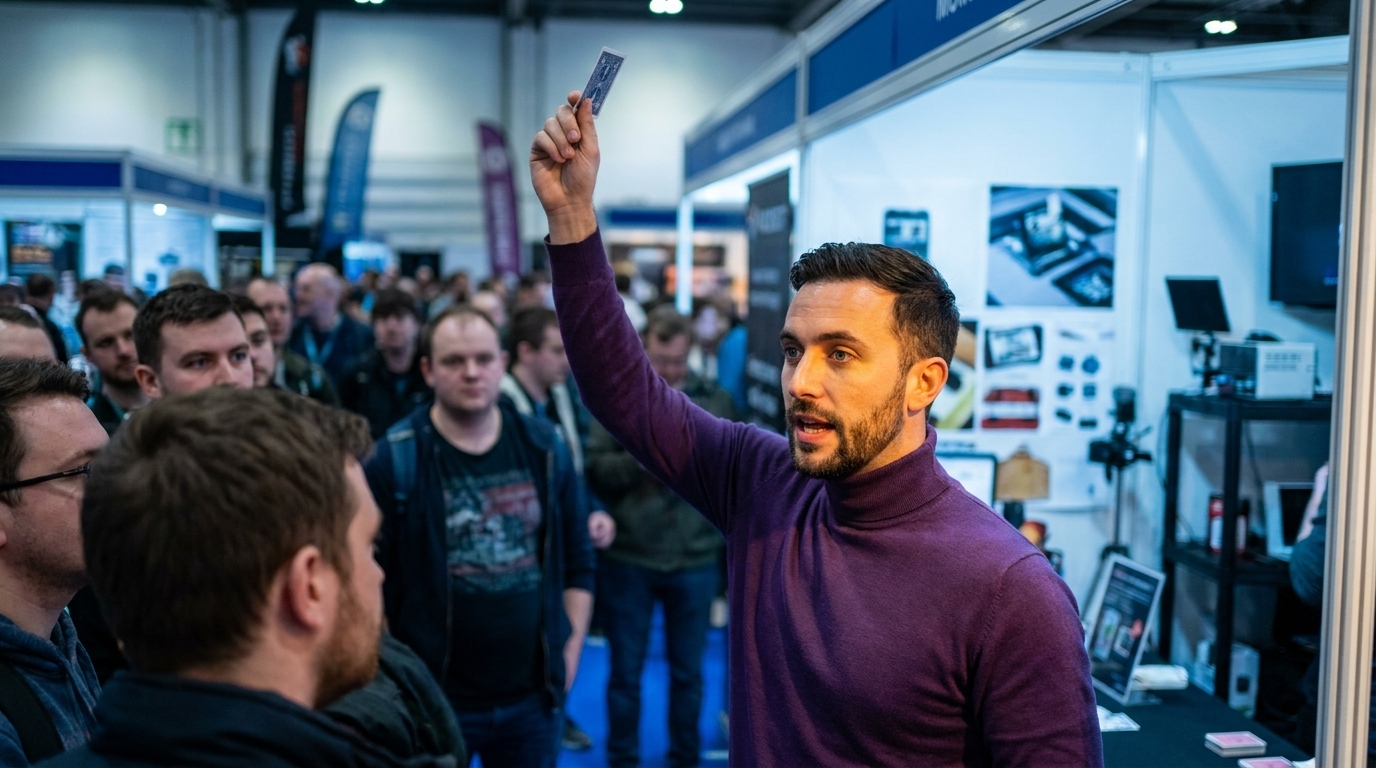
The honest answer: a presenter converts a hallway into an audience, and then hands that audience to your sales team before it cools down.
That is three separate skills, and most people only evaluate the first one.
Stopping people is the loud part. It is also the easiest to fake. Anything bright and loud will stop traffic once. The harder part is the middle, holding thirty strangers for two to four minutes without losing them to the stand opposite, and the hardest part is the handoff, moving a warm person to a conversation with your rep without the awkward moment where everyone drifts away at the same time.
In my own booth work I plan on a cycle of roughly four to six minutes: gather, perform, qualify, hand over, reset. On a busy day that runs twelve to fifteen times per hour, with a break every fifty minutes because a voice that has been projecting over a convention hall PA system for six straight hours on day one is not available on day three. Anyone who tells you they can perform continuously for eight hours is either using a microphone and a chair, or lying to you.
Presenter, host, or performer, which one do I need?
Three different hires, and companies mix them up constantly.
- The product presenter. Learns your demo, delivers it accurately, repeats it all day. Best when the product itself is genuinely interesting to look at and your problem is staffing, not attention.
- The host. Runs games, draws, giveaways, keeps energy up, collects details. Best when your main goal is lead volume and the prize is doing the heavy lifting.
- The performer. Creates the crowd out of nothing, with a skill that has no connection to your product until the final thirty seconds, when it does. Best when you are in a hall with 400 other stands and nobody has heard of you yet.
I sit in the third category. As a trade show magician and mentalist, my job is to make people stop for a reason they cannot quite justify, and then be useful about it. If you want someone to recite your feature list with perfect accuracy forty times a day, hire a presenter who specialises in exactly that. They exist, they are good, and I am not better at it than they are.
How do I brief a presenter so the leads are actually usable?
This is where most booth programmes quietly fail, and it is almost never the presenter's fault.
The brief I need is not your brochure. It is three things:
- One sentence describing what you sell, in the words a stranger would understand. Not the positioning statement. The elevator version your CTO uses at a wedding.
- The disqualifier. Who should I politely not hand over? If your product only works for companies above 200 employees, tell me, and I will steer accordingly instead of filling your reps' day with the wrong conversations.
- The handoff line. Who do I name, and what do I say? "Talk to Dana, she runs the integrations" works. "Someone from the team will help you" does not.
Give me those three and the first morning runs clean. Skip them and I spend day one reverse engineering your business from overheard sales calls, which I will do, but it costs you a few hours of good traffic.
How many leads should I expect from a presenter?
I will not give you a number, because anyone who gives you a number before seeing your hall position, your aisle width and your competition is guessing out loud.
What I will tell you is the mechanic that moves the number. The crowd size you see is vanity. The figure that matters is how many people from each gathering your team actually speaks to afterwards. If a presenter draws forty people and your two reps convert four conversations, the presenter is working and your floor staffing is the bottleneck. I have watched companies blame the act when the real issue was that both reps were at lunch at the same time.
A crowd with nobody to catch it is just a very expensive traffic jam in front of your stand.
Rough working ratio from my own stands: you want at least one available team member for every ten to twelve people in the gathering. Below that, the surplus walks.
When is a presenter the wrong hire?
Here is the part that costs me work.
If your stand is three metres by two, in a side aisle, with a table in the middle and no clear sightline, a presenter will make it worse. You will have a bottleneck, your own staff will be trapped behind furniture, and the neighbours will complain to the organiser by eleven in the morning. Fix the layout first. I have written separately about booth ideas that genuinely stop people, and most of them cost less than hiring me.
Second case: if your show is a closed, invitation-only industry event with ninety attendees who all already know you, you do not need crowd generation. You need good coffee and a quiet corner. Spend the budget there.
Third case: if the goal is a serious opinion shift in the room rather than traffic, that is a stage job, not a booth job, and it belongs to a keynote speaker slot in the conference programme. Different room, different build, different hour of the day. Some of what happens in that room I described in the piece on what a keynote actually does.
What should I ask before I book anyone?
Four questions, and the answers tell you more than any showreel.
- How long is one cycle, and how many per hour?
- What do you need from my team during the handoff?
- What happens if the hall is half empty at ten in the morning?
- What is in your contract about sound levels and neighbouring stands?
That last one is not paperwork pedantry. Most organisers have a decibel limit and a rule about not projecting into the aisle. A presenter who has never read one of those documents will get you a warning letter, and I have been in the room when it happened to the stand next door. (They turned the speaker down. Nobody stopped after that.)
If you want the same logic applied to an evening event rather than a booth, the way a mentalist show is built for a seated audience is a separate conversation, and I have laid out the differences in a piece on what happens on a stage.
So what do you decide now?
Not whether to hire me. Decide something smaller and more useful: walk your floor plan and count how many of your people will be free, standing, and facing the aisle at any given moment during peak hours.
If the answer is fewer than two, a presenter is premature. Fix the staffing rota first, and you may find you need less help than you thought.
And if the answer is four or five capable people standing around with nothing to catch, that is the real problem a presenter solves. Which one is your stand?
Questions people ask
How many hours a day can one presenter realistically work?
Plan for six to seven performing hours with a break roughly every fifty minutes. Projecting over a convention hall destroys a voice faster than people expect, and a presenter who runs flat out on day one is noticeably weaker by day three. On a three-day show I build the schedule around peak traffic windows rather than covering every open hour.
Do I need a microphone and sound system for a booth presenter?
Often no, and sometimes you are not allowed one. Most organisers cap sound levels and forbid projecting into the aisle. For gatherings of twenty to forty people a trained voice carries without amplification. If your hall is unusually loud, ask the organiser for the written sound rules before you buy any equipment.
Can a presenter collect leads directly instead of my sales team?
They can scan badges, but it is usually the wrong use of them. Every thirty seconds spent typing details is thirty seconds not building the next crowd. The better split is that the presenter qualifies verbally and names a specific team member, and your staff does the scanning and the real conversation.
How far in advance should I book a presenter for a major show?
For the big international halls, availability tends to go months ahead because the main shows in any sector happen on the same fixed weeks every year. I would not promise any particular date here, but the practical rule is this: book once your stand position is confirmed, because the position changes what the act should be.
What happens during the dead hours when the hall is empty?
Good presenters do not perform to an empty aisle, it kills the energy for the rest of the day. In slow windows I work small, one or two people at a time, close to the stand edge, which is also when the most serious buyers tend to walk. Ask any candidate how they handle this and listen carefully.

Who writes here
Neta Bresler, mentalist and perception researcher. Ranked 7th in the world in mentalism, featured on Netflix, performing and speaking for companies and conferences in Israel and abroad. Everything here comes from the stage, not the library.
More about Neta