Trade Show Entertainment Ideas, Sorted by Job
A working list of trade show entertainment ideas, grouped by what each one does for your booth: stopping traffic, holding attention, or starting a real conversation.
8 min read
- Featured on Netflix
- Ranked 7th in the world in mentalism
- Shows and keynotes for companies
On this page
You have a stand, a budget line that says "activation", and a memory of last year, when people walked past you toward the company with the coffee machine. So now you are collecting ideas. A caricaturist. A VR headset. A putting green. Someone mentioned a robot.
Here is the thing nobody tells you while you are making that list: entertainment on a show floor is not one job. It is three. Stopping someone. Holding them. Handing them to your sales team in a state where they are willing to talk.
Most ideas do one of those well and quietly ruin the other two.
So below is a list, but sorted by job rather than by novelty. Read it against the hole in your own floor plan.
Trade Show Entertainment Ideas That Stop Traffic
Movement, a human face, and a reason to believe something is about to happen in the next few seconds. That is most of what makes a person brake in an aisle.
Screens lose. A hall at a large expo has hundreds of them, and the visiting eye has written them all off by about 10:30 on day one. Smell works better than people expect (popcorn, coffee, anything baking) but it delivers people who want the thing that smells good, which is not the same as people who want your platform.
What reliably stops traffic is a small crowd. People stop because other people stopped. Anything that builds a cluster of eight to twelve standing bodies is doing the real work, because the cluster is the advertisement.
- A short repeating live act at a fixed spot on the booth edge. Three to five minutes, running roughly every quarter of an hour, always from the same square metre so staff know where to stand.
- A physical skill demo. Latte art, calligraphy on name badges, speed-sketching, knife-free sushi rolling, a barista pulling shots by hand. People watch hands doing difficult things.
- A live leaderboard for a game that takes under ninety seconds to play. The screen matters less than the names on it.
- A reaction-time or grip-strength test. Crude, loud, instantly understood from eight metres, and men in their fifties cannot walk past one.
- A caricaturist or portrait artist, purely as a magnet. Strong stopper, weak closer, more on that below.
- A sketch-note artist drawing the show itself on a big board, which grows across the three days and gives people a reason to come back.
Ideas that look excellent in the deck and underperform on the carpet: the prop-filled photo booth (fun, almost zero conversation), the massage chair (your visitor is now horizontal and asleep), the wheel of prizes (attracts bag-collectors with astonishing efficiency). I have written more about the physics of the stop itself, including where you personally stand, in this piece on booth ideas that stop people.
Ideas That Hold a Crowd and Create a Handover
This is where most activations fall apart. You pay for something that pulls a crowd, the crowd forms, and then it dissolves because nothing in the format creates a moment where the visitor turns toward your team.
Watch for one thing: does the activity end with the visitor facing your staff, or facing the exit?
A caricaturist ends with someone holding a drawing and walking away. A VR headset ends with someone pulling plastic off their face, mildly dizzy, hunting for a surface. Both are pleasant. Neither hands anybody over.
- Participation with a residue. The visitor did something, something surprising happened involving them personally, and for about twenty seconds they want to tell someone. If a salesperson is standing there, that gets spent on your company. If not, it gets spent on a colleague in the next aisle.
- Live trivia on your category, run by a host with a microphone, three questions, small prize. It generates a scoreboard, a laugh, and an obvious opening line for your team.
- A guess-the-number or estimation challenge where the answer is a real figure from your product data. People argue about it, which buys you ninety seconds.
- A short quiz on a tablet that produces a result about the visitor, not about you. Profiles, archetypes, risk scores. People read their own result out loud.
- A build-something table. Lego, circuits, a two-minute assembly race. Hands occupied, eyes free, conversation easy.
- A mini competition with a daily winner announced at a fixed hour, say 16:00. It creates a second visit, which is the cheapest lead you will get all week.
Which is why I ask every client the same unglamorous question before anything else: how many people are on the stand, and who is assigned to catch?
Does the Entertainment Need to Match What We Sell?
Less than the marketing team thinks, more than the performer usually admits.
Forced thematic tie-ins hurt. If you sell industrial valves and the magician keeps producing a tiny valve from behind someone's ear, everyone can feel the effort. The audience goes polite, which is the worst thing an audience can go.
What works is connecting at the level of the idea, not the prop. A lot of my work is with companies in fraud prevention, behaviour analytics and user psychology, and there the link is almost free: everything I do is about how attention gets steered and how certainty gets manufactured. A security company does not need a padlock pulled out of the air. They need the visitor to walk away having personally felt how easily a confident person is wrong about what they just saw. That lands, and the salesperson inherits a sentence to open with.
If you cannot find an honest idea-level link, drop it. Good entertainment plus a real conversation beats a themed sketch about workflow efficiency.
What a Live Performer Adds Over a Game or a Screen
Adaptability, mostly. A screen plays the same thing at 09:15 on a dead morning and at 14:00 when forty people are packed in. A person adjusts.
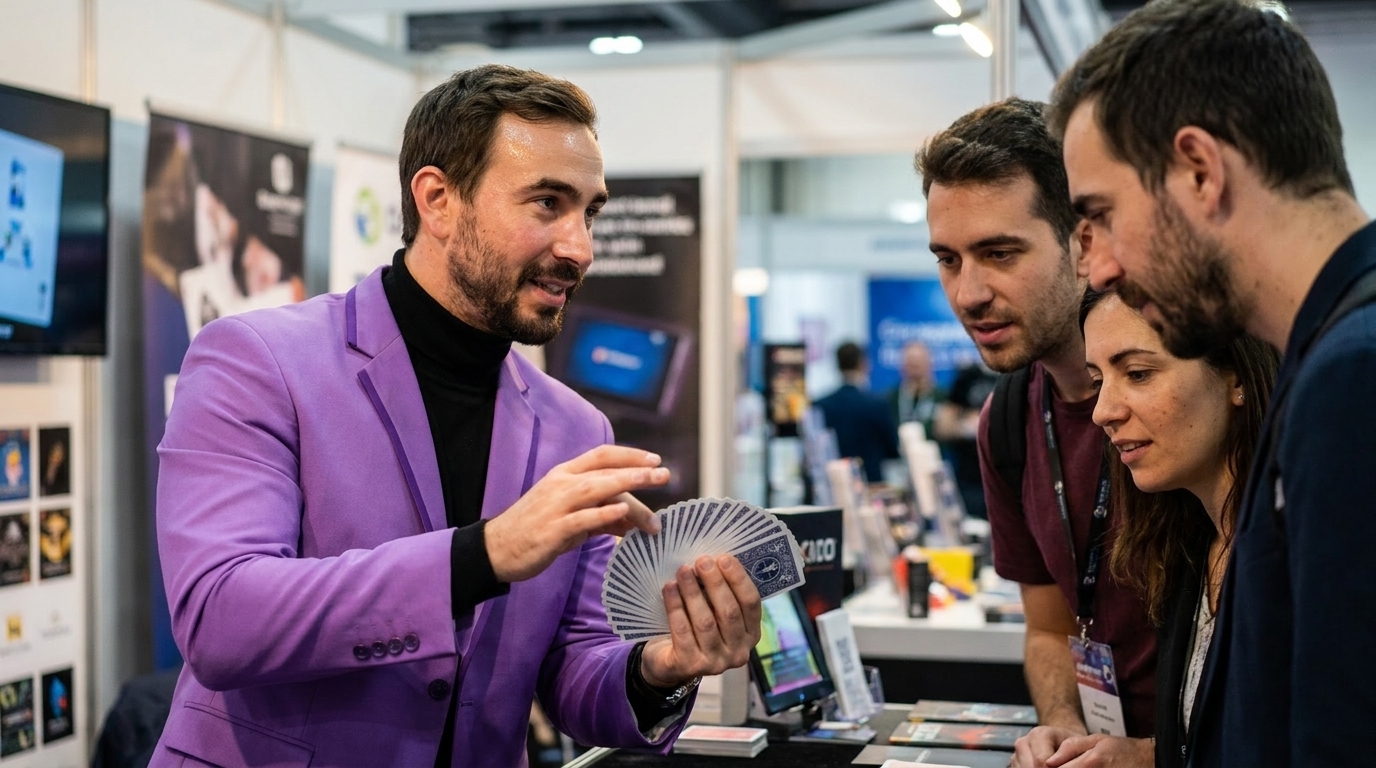
When I run trade show entertainment as a trade show magician, I am reading the aisle constantly: who slowed, who is carrying a competitor's bag, who looks like a decision maker travelling with two juniors. On a quiet stretch I work one person in detail. When traffic builds I switch to material that reads from eight metres and builds a cluster fast.
The second thing a person adds is qualification. Within a minute I usually know whether someone is a buyer, a student, or a man collecting pens for his children. The first one goes to your team, the third one gets a warm thirty seconds and a friendly send-off. No prize wheel does that. The longer version of how this kind of set is built is in the article on the mechanics behind a mentalism set.
When Live Entertainment Is the Wrong Call
Here is the part that costs me work, and I would rather say it now than halfway through a contract.
Do not hire a performer if your stand is under about nine square metres and already holds a meeting table. There is nowhere for a crowd to stand without blocking your own conversations, and I will be actively hurting you. I have turned down stands for exactly this.
Do not hire one for an invite-only technical expo where every visitor arrives with a pre-booked meeting schedule. Nobody is browsing. Spend the budget on better coffee and a quieter room.
Do not hire one if nobody on your team has been told a performer is coming. I have arrived at stands where the staff assumed I belonged to the neighbouring exhibitor. That is a briefing problem, not a performance problem, and fifteen minutes with the team before doors open solves it.
And if what you need is forty-five minutes on a main stage rather than three minutes in an aisle, that is a different engagement: closer to a mentalist show for a corporate audience, or to the attention and belief material I deliver as a keynote speaker. Different muscle, different room, and the differences are laid out in the piece on what a keynote speaker does on your stage.
How to Choose Between the Ideas on Your Shortlist
Put each item through three questions. Does it stop someone from eight metres away? Does it end with the visitor facing my team? Can it survive both a dead Tuesday morning and a packed Wednesday afternoon without changing?
Most ideas score one out of three. A few score two. The ones that score three are usually a person, because people flex and props do not.
So before you book anything, go stand in your own aisle at the busiest hour of your last show and answer honestly: at which exact moment do you lose them? The walk-past, the hover, or the handover?
If you know the answer and you are not sure which format fixes it, send me your stand size, your hall, and the one sentence you want visitors repeating afterwards. I will tell you whether a performer belongs there, and if the honest answer is no, I will say so in the first email.
Questions people ask
How many hours a day should a performer work the booth?
Four to five hours of floor time per day is the realistic ceiling for close-up work, usually split into blocks of forty to fifty minutes with short breaks. Beyond that the quality of reading the aisle drops and so does your conversion. If your hall runs eight hours, pick the two or three busiest windows rather than spreading the same hours thin across the whole day.
What size stand do we need for live entertainment to work?
As a rough constraint, you want at least nine to twelve square metres, plus room for eight to twelve people to stand without spilling into the aisle or blocking your meeting table. Corner and peninsula stands work best because a crowd can form on two sides. If your only open edge is one metre wide, a seated activity will serve you better than a crowd-builder.
Should we give away prizes alongside the entertainment?
Prizes change who stops. Generic giveaways pull bag-collectors; a single meaningful prize awarded at a fixed hour each day pulls people who come back. If you do run a prize, tie entry to a short conversation with a staff member rather than a dropped business card, otherwise you collect a list of names nobody at your company can remember meeting.
How far in advance should we book for a large exhibition?
For major international shows, booking three to six months out is normal, simply because performers get held for the same dates by several exhibitors at once. Smaller regional events are often workable with a few weeks' notice. Either way, send your stand number and hall as soon as you have them, because the layout changes what the act should be.
Can the entertainment collect leads for us?
It can qualify, not collect. A performer can tell within a minute whether someone is a buyer, a student or a passer-by, and steer the buyer toward your team. Actual data capture should stay with your staff or a tablet, because the moment a performer starts typing, the crowd disperses and the next cluster never forms.

Who writes here
Neta Bresler, mentalist and perception researcher. Ranked 7th in the world in mentalism, featured on Netflix, performing and speaking for companies and conferences in Israel and abroad. Everything here comes from the stage, not the library.
More about Neta