Trade Show Games: Which Ones Earn a Conversation
A working look at trade show games, from prize wheels and Plinko to vaults and cornhole, and which formats actually produce conversations instead of handing out pens.
15 min read
- Featured on Netflix
- Ranked 7th in the world in mentalism
- Shows and keynotes for companies
On this page
- Do trade show games actually bring people to the stand?
- Why does our prize wheel produce bad leads?
- What makes a game hold someone for three minutes instead of eleven seconds?
- Which trade show games are worth the floor space?
- Is a performer just a very expensive game?
- Can we combine a game and a performer?
- When should we skip games altogether?
- How do we brief the team so the game is not wasted?
- What should we actually decide before the show?
You have a stand, a target number of leads, and someone on the team has just said the words "let's do a spin-the-wheel." Does that actually work, or are you about to spend budget on a wheel that lives in a warehouse for the other 51 weeks of the year?
I have stood inside a lot of booths. Not as a visitor, as the thing in the booth that is supposed to make people stop. So I have watched games succeed and watched them fail from about a metre away, which is a very unflattering distance.
Here is what I have learned about which ones earn a conversation and which ones just move merchandise out the door.
Do trade show games actually bring people to the stand?
Some do. The ones that work share a single property: a stranger can understand the game from outside the stand, without being spoken to.
That is the whole test. An exhibition aisle is a hostile place for anything that needs explaining. People walk it with their shoulders slightly forward, phone in hand, already late for a meeting on the other side of the hall. If your game requires someone to walk in, be greeted, and then listen to thirty seconds of setup before they know whether they want to play, you have built a game for people who already decided to visit you.
A prize wheel passes the test. You see it, you understand it, you know what is being asked of you. A trivia quiz on an iPad fails it almost every time. Nobody can tell from the aisle whether it is three questions or thirty, and the downside risk (looking stupid in front of strangers in your own industry) is real.
So yes, games bring people in. The harder question is what kind of people.
Why does our prize wheel produce bad leads?
Because a prize wheel is a transaction, and the visitor knows the terms before they walk over. Scan my badge, I spin, I get a thing, I leave. The whole exchange takes about eleven seconds. Nobody involved is pretending otherwise.
That is not useless. If your goal is raw badge volume at a show where your product is already well known, a wheel is an efficient machine. I have seen teams hit their scan target by lunchtime on day one.
But badge volume and conversation are different outputs, and most briefs I see quietly want both. The wheel gives you the first and actively prevents the second, because the visitor's internal clock is already counting down to the exit. They came for a resolution, not a discussion. Your sales rep gets maybe four seconds of attention while the wheel is still turning, and then the prize lands and the attention leaves with it.
If you have ever read your post-show lead list and thought "who are these people," the wheel is usually the answer.
What makes a game hold someone for three minutes instead of eleven seconds?
Three things, and the order matters.
- The outcome has to be uncertain. A wheel is random, which feels like uncertainty but is not. Nobody is invested in a random result. Something where the visitor's own choice or thinking affects the ending holds them completely differently.
- Other people have to be able to watch. A game played alone on a tablet produces a lead. A game played in front of six strangers produces an audience, and audiences grow. This is the single biggest multiplier available to you and most stands design it out by accident, by putting the game in a corner facing a wall.
- There has to be a reason to stay after it ends. If the prize is the ending, the visitor leaves at the ending. If the surprise is the ending, they want to tell someone about it, and the nearest person to tell is standing next to them wearing your logo.
That third point is where most of the value is. A good moment leaves someone slightly off balance and looking for a human to process it with. That gap is where your sales team actually gets to work.
Which trade show games are worth the floor space?
Here is the honest run through the usual suspects, each one measured against the same question: does it buy you eleven seconds or three minutes, and can a crowd see it happening?
- Prize wheel. Eleven seconds, reliably. Readable from the aisle, cheap to run, no staff training needed. Best when you are a known brand and the brief is scan count. Worst when your product needs explaining, because the visitor has already mentally filed you as "the pen people."
- Plinko. Slightly better than the wheel, and the difference is interesting. The chip takes four or five seconds to fall, and in those seconds the player is genuinely watching something, which means the person next to them watches too. It is still a random outcome with a prize ending, so expect twenty to thirty seconds, not three minutes. The upside is that Plinko boards are loud and vertical, and vertical things are visible over shoulders in a crowded hall.
- Digital scratch-offs and app-based instant wins. These are lead capture dressed as a game. They work if your goal is clean data straight into the CRM, and they fail every part of the watchability test, because the action happens on a phone screen that only one person can see. If you use them, use them as the exit of an interaction, not the entrance.
- Memory match and matching contests. Better than people expect. A matching game takes real thinking, the player's choices change the outcome, and bystanders can see the board and silently play along. (Bystanders who are silently playing along are, for my purposes, the single most valuable people in the aisle.) Keep the grid small enough that a round lasts under ninety seconds or you will block your own entrance.
- Cornhole, putting greens, basketball hoops. Physical skill games have a quality the digital ones never get: failure is public and funny, and success gets a reaction from strangers. Three minutes is realistic. The cost is floor space and noise, and both are real. A putting green eats two to three metres of length you probably needed for meetings.
- Vault or safe cracking. A locked box, a code, one attempt per visitor, one big prize at the end of the show. This is the best of the prop based games in my experience, because it has a narrative that runs all three days, people come back on day two to check if anyone has opened it, and it gives your staff a perfect non-salesy opening line. It needs a visible prize and a visible countdown of attempts, or it quietly becomes another raffle.
- Claw machines and arcade cabinets. Enormous stopping power, genuinely enjoyable, and almost no conversational hook. People queue, play, win or rage, and leave. Treat it as a crowd magnet only, and make sure you have staffed the queue, because the queue is where the actual talking is possible.
- VR headsets and racing simulators. The person inside the headset is having a wonderful time and is completely unavailable to you. Everyone else is looking at someone waving their arms. If you use VR, mirror the feed to a large screen facing the aisle, otherwise you have bought a very expensive chair.
- Giant Jenga and oversized versions of normal games. Scale alone gets attention. The tension before a tower falls is real tension, which is why it works. It also ends in chaos and a loud noise, which is either exactly what you want or a reason your neighbours will stop speaking to you by day two.
- Trivia leaderboards. The leaderboard saves the format. A quiz alone is private and risky; a quiz with a visible scoreboard and a prize for the top score at 16:00 gives people a reason to return, and returning visitors are the ones your team actually has time to talk to properly.
- Passport or stamp hunts across multiple stands. Usually run by the organiser. Great for footfall, useless for qualification. Visitors arrive, say "stamp please," and go. If you take part, put the stamp at the back of the stand rather than the front edge. That one decision changes who walks past your product.
- Charity tie-in games. Every play donates a fixed amount to a named cause. The motivation changes from greed to something softer, and the conversation that follows is noticeably warmer. It also stops the professional freebie hunters, who can smell a non-prize from forty metres.
Notice the pattern. Everything that buys you three minutes has either a public outcome or a decision made by the player. Everything stuck at eleven seconds is random, private, or both.
Is a performer just a very expensive game?
Fair question, and worth answering honestly.
A wheel costs you once and runs for three days. I cost per day and need to sleep. On pure cost per badge, the wheel wins and I am not going to pretend the arithmetic says otherwise.
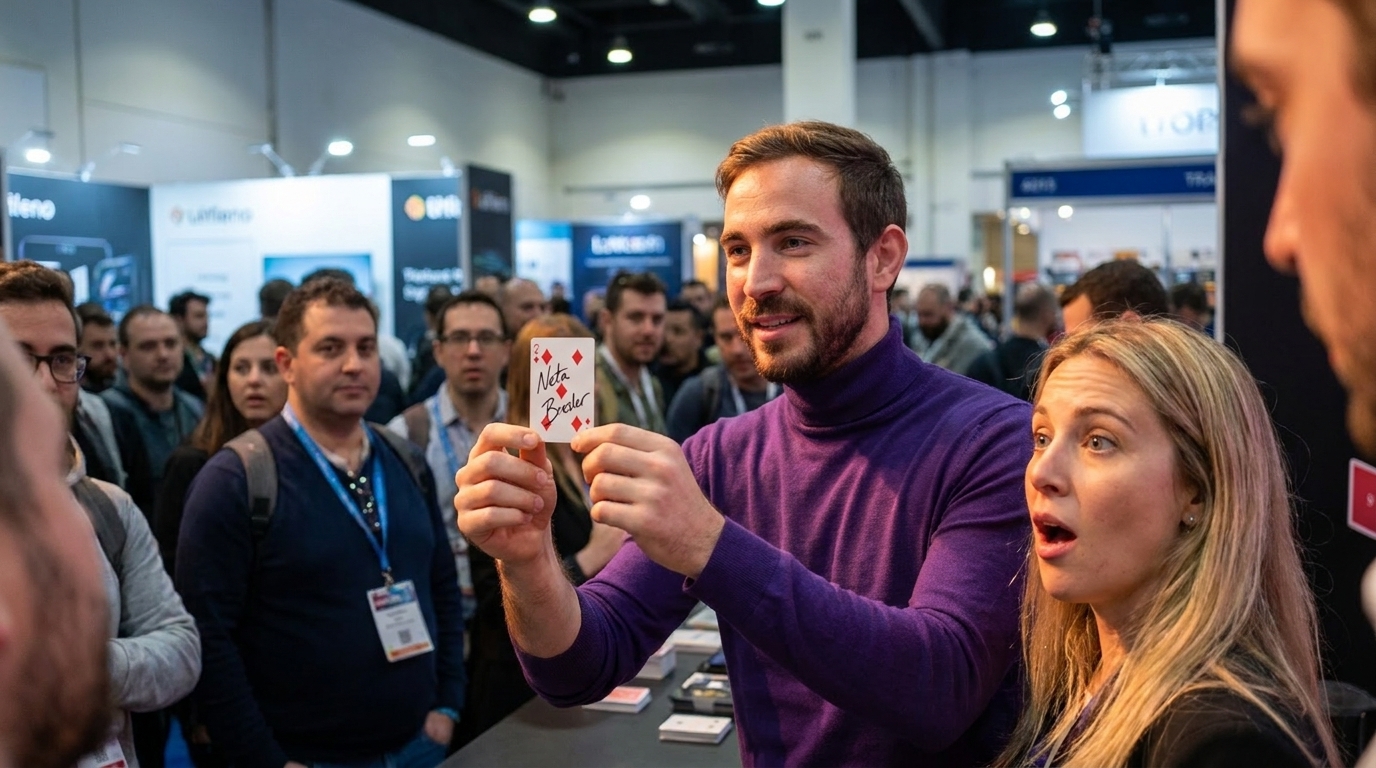
What changes the calculation is the shape of the crowd. When I work a stand as a trade show magician for booth traffic, I am running short sets of roughly six to eight minutes, repeated through the day, with a few minutes of handover in between so the team can actually talk to the people who just gathered. On a normal exhibition day that lands somewhere around twelve to eighteen sets, and a working set holds between fifteen and forty people depending on how much aisle you have. The thing a game cannot do is read a crowd and change the ending for the specific person who is clearly the decision maker, because I can see who the rest of the group keeps glancing at.
I use mentalism rather than object manipulation for a specific reason: the volunteer's own choice is the content. Nothing happens to them, something happens from them. That turns a spectator into a participant without ever making them the butt of anything, which matters a great deal when the participant is a senior buyer in a suit. (If you want the mechanics of that rather than the booth application, I wrote separately about what a mentalist actually does on your stage.)
There is also a timing argument. A prop runs at a constant rate all day. A human does not, and that is an advantage, because exhibition halls have rhythms. The dead hour after lunch on day two needs a very different approach from the first ninety minutes of day one, when everyone is fresh and curious and nobody has collected anything yet. I will shorten sets when the aisle is thin and stretch them when a crowd is building, and no wheel will ever do that for you.
Can we combine a game and a performer?
Yes, and it is usually the best version of this.
The structure that works: the prop runs continuously as a visual anchor, and the live sets run on a published schedule so your team can say "come back at twenty past, you'll want to see this." That sentence is a legitimate reason to take a name and a company. The game catches the passive walkers, the sets create the peaks, and the gaps between them are where meetings get booked.
One constraint worth planning around: do not run both at the same moment in the same square metre. Two attention sources in one small space split the crowd and neither gets a full audience. Put the prop at the front edge and the performance space slightly deeper, or stagger them in time.
And if your team is also doing a stage slot in the main hall that week, note that the same material does not transfer directly. A booth set and an evening mentalist show for a corporate audience are built on different assumptions about attention: one has to earn it every eight minutes from scratch, the other has it from the first second and has to deepen it.
When should we skip games altogether?
There are shows where I tell people not to hire me, and I would rather say it here than in a meeting after you have paid a deposit.
Skip the entertainment if your stand is a pre-booked meeting operation. If your three days are already wall to wall thirty minute appointments with named accounts, a crowd outside your stand is not traffic, it is noise, and your own sales people will come to resent it by hour two. I have been in that situation and it is a bad use of everybody's day.
Skip it also if your booth is under roughly nine square metres with no usable aisle frontage. A crowd needs somewhere to stand that is not blocking the hall, and some venues will send a floor marshal over within minutes if you encroach. A game that gets shut down by the organiser at 10:40 on day one is worse than no game.
And skip it if the product itself is the spectacle. Heavy machinery, a working robot, something that moves and makes noise. You already have the stopping power. Adding a performer in front of it is just competition for the same four seconds of attention. In those cases the better fix is usually structural, which is really a question of stand layout and sightlines rather than booking anybody, and I have put the practical version of that into a piece on booth ideas that actually stop people.
How do we brief the team so the game is not wasted?
This is the part nobody plans and it decides everything.
Whatever game you choose, somebody has to own the moment immediately after it ends. Not "be nearby." Own it. One named person per shift whose only job is to step in within two seconds of the result and say something that is not about the prize.
A few things worth agreeing in advance:
- Decide what a qualified lead means before the doors open. If every scan counts, every scan will be collected and none will be useful.
- Give the team one opening line that is a question about the visitor, not about your product. People answer questions about themselves. They deflect pitches.
- Agree a handover signal. When I am working a stand I will often hand a crowd directly to a specific rep by pointing. The rep has to know that is coming or the moment evaporates.
- Rotate the staff off the game every ninety minutes. Enthusiasm at a prize wheel is a perishable good and visitors can hear it going flat.
If you are also sending someone to the conference programme that week, the same thinking applies on a bigger scale, and the piece on what a keynote speaker actually does on your stage covers how a session can feed your stand rather than sit separately from it.
What should we actually decide before the show?
Not "which game." Decide the output first.
If you need badges, buy the wheel, put a target number on the wall, and judge it on scans. Nobody should feel bad about this. It is an honest tool doing an honest job.
If you need conversations with a specific kind of person, then the question becomes who you want standing in your aisle and what would make that person stop when they had already decided not to. That is a harder brief and it usually cannot be solved by a prop, because props do not adapt and people do.
So before you approve anything: look at your lead list from the last show and count how many of those names your sales team ever called back. If the answer embarrasses you slightly, the problem was never the game. It was that the game ended before anyone had a reason to talk.
Which of those two outputs does this show actually need from you? If it is the second one, send me your stand plan and the hall you are in, and we can talk through how a crowd at your front edge turns into actual conversations with the people you came to meet. Even if the answer turns out to be a very good vault and a well briefed team, you will leave that conversation knowing why.
Questions people ask
How big does our booth need to be for a game with a crowd?
As a rough working figure, under nine square metres with no usable aisle frontage is too tight. A crowd needs somewhere to stand that does not block the hall, and many venues will send a floor marshal over within minutes if visitors spill into the aisle. If space is tight, choose a vertical prop like a Plinko board rather than anything that creates a queue.
What prize actually works at a trade show?
One good prize beats two hundred cheap ones. A single meaningful item awarded at a fixed time each day gives visitors a reason to come back, and a returning visitor is someone your team can speak to properly. Branded pens attract people who collect branded pens. If you want a softer motivation, a charity donation per play changes the type of person who stops.
Should the game be at the front of the stand or the back?
Front edge for visibility, but never so far forward that the queue stands in the aisle. If you are part of an organiser-run stamp hunt, put the stamp at the back instead, so visitors walk past your product and your staff on the way. The rule is simple: whatever people want, make them travel a few metres through your message to reach it.
How many people can a live performance set hold at a booth?
In my experience a working set holds roughly fifteen to forty people, depending entirely on how much aisle frontage you have. I run sets of about six to eight minutes with handover gaps so the team can talk, which lands around twelve to eighteen sets across a normal exhibition day. Narrow frontage caps the crowd long before the material does.

Who writes here
Neta Bresler, mentalist and perception researcher. Ranked 7th in the world in mentalism, featured on Netflix, performing and speaking for companies and conferences in Israel and abroad. Everything here comes from the stage, not the library.
More about Neta