How to Attract People to Your Trade Show Booth: A Field Guide
How to attract people to your trade show booth, from someone who has spent years standing in one: what stops traffic, what wastes money, and what to skip entirely.
11 min read
- Featured on Netflix
- Ranked 7th in the world in mentalism
- Shows and keynotes for companies
On this page
- How to attract people to your trade show booth when nobody wants to stop
- What actually makes someone break stride?
- Do lighting, big screens and a strong stand design help at all?
- What should happen before the hall doors even open?
- Do giveaways and prize wheels work?
- Where does a performer fit into this?
- When is hiring a performer the wrong move?
- What should the staff be doing while all this happens?
- So what do you do with all this?
You have paid for the space, built the stand, shipped the banners, and booked four people on flights. And now you are standing in a 3x3 metre box watching the aisle walk past you at a steady 1.4 metres per second, eyes forward, badge flipped backwards, phone up.
So the real problem is not decoration. The problem is how to interrupt a person who had already decided, before they turned into your aisle, that they were not stopping.
That is a perception problem before it is a marketing problem. And I spend my working life inside perception problems.
How to attract people to your trade show booth when nobody wants to stop
Start by accepting that "looks good" is not a reason to stop. It is a reason to not be embarrassed.
Walk a hall at 10:30 on day one and count what you see: clean graphics, a screen playing a loop, a bowl of branded pens, three people in matching polo shirts standing shoulder to shoulder behind a counter. Every booth. Dozens of them. The visitor's brain classifies the whole row as one object and moves on, because anything that looks like the category gets processed as the category.
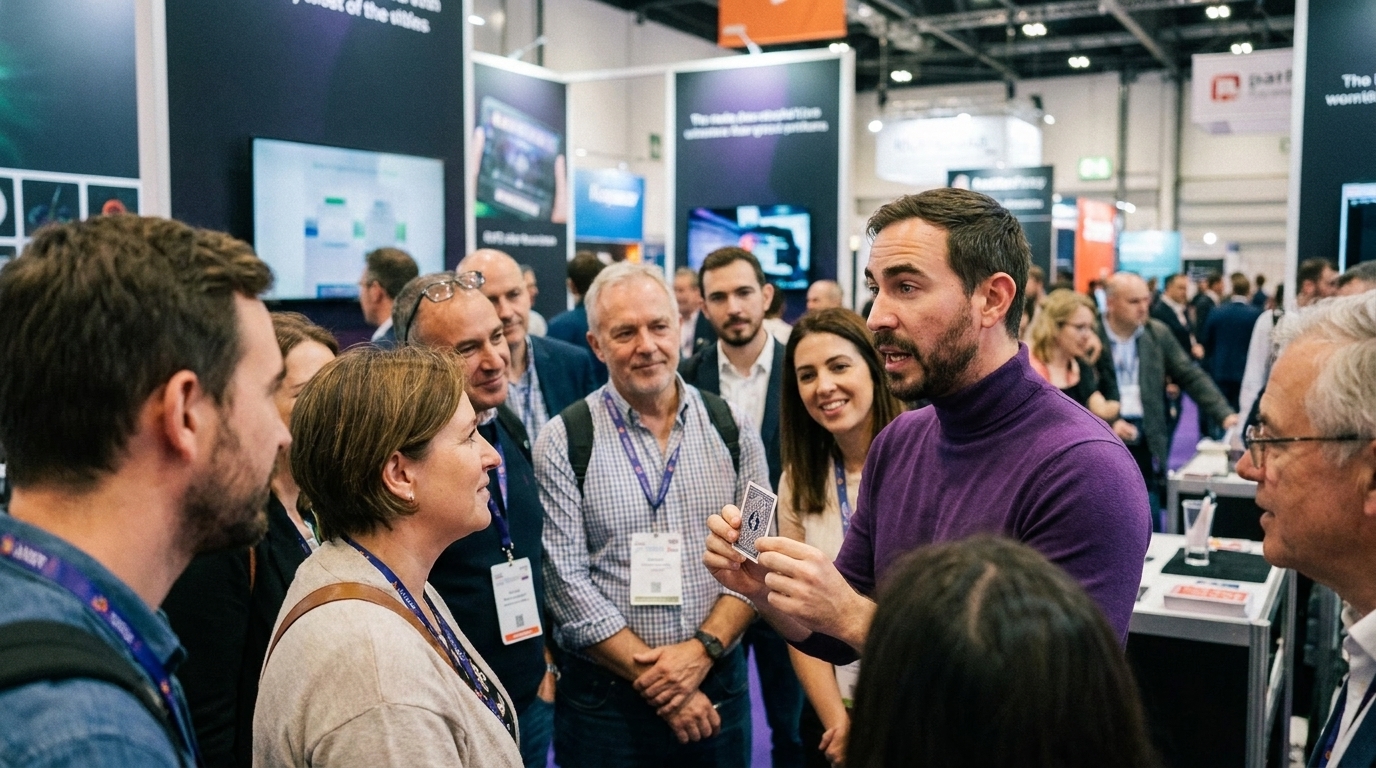
Attention does not go to the nicest thing. It goes to the thing that breaks the pattern. One booth on that row has a small group of people laughing at something, and that group has a shape: shoulders turned inward, heads tilted. From forty metres away you cannot see what they are looking at, and that is exactly why you walk over.
Human beings are drawn to other human beings who are visibly interested in something. That is the whole engine. Everything below is a way of starting it.
What actually makes someone break stride?
A few things do, reliably. I have tested all of them from inside the box.
- Another person stopping first. The hardest unit of traffic to get is the first one. After three people are standing there, the cost of joining drops to almost nothing, because stopping no longer looks like a commitment, it looks like being part of something.
- A sound that is not a sales pitch. Laughter. A gasp. Applause. Not a microphone saying your product name, which the hall filters out within ten minutes of opening.
- Something happening at eye level, outside the counter. Counters are walls. If the interesting thing is behind the wall, nobody can see it is interesting.
- A question they can answer in under two seconds. Not "are you interested in workflow automation". Something closer to "think of a number, any number, don't say it out loud".
And one more that is less obvious: a visible end point. People do not stop when they cannot see how they get away. If the thing happening at your booth clearly lasts four or five minutes, they will give you four or five minutes. If it looks like it ends when a salesperson decides it ends, they will keep walking.
Do lighting, big screens and a strong stand design help at all?
They help, and they are not optional, and they will not carry the booth on their own. Here is the honest division of labour.
Lighting works at distance. A stand that is two or three times brighter than the aisle reads as "open" from far away, and a dim stand reads as closed even when four people are standing in it. Overhead spots aimed at the faces of your team, not at the graphics, do more for traffic than any banner, because the thing a visitor scans for in a hall is a human face that is lit well enough to be read. Hanging signage matters for the same reason: it is the only element visible over the heads of the crowd at the booth in front of you.
Screens are where the money usually goes wrong. A looping product video is pattern, not interruption. Nobody is going to stand in a hall and watch ninety seconds of motion graphics unless they already care, and if they already care they would have stopped anyway. Interactive screens are better, because a touch is a commitment and a commitment is the start of a conversation, but only if the screen sits on the aisle edge and a human being is standing next to it saying something. A touchscreen with nobody beside it becomes a place where one visitor hides from your staff.
So: use light to make the booth visible, use design to make it legible in two seconds, use screens to hold someone once they are already inside. The thing that actually breaks stride is still a person. I have seen a beautifully lit stand with a wall of 4K screens sit empty next to a plain pipe and drape unit with a crowd around it. The difference was one person doing something in the open.
What should happen before the hall doors even open?
Most of the traffic you can control is booked before you fly. The visitors who matter most are the ones who arrive at your stand already intending to, and that intention is built two to four weeks out.
Email your existing customers and your warm pipeline with the stand number and a specific reason and a specific time. "Come say hello" does nothing. "We are at B-142, and at 11:00, 13:00 and 15:00 each day there is something happening at the stand that takes four minutes" gives a person a slot to put in a calendar. Post the same thing on the event hashtag, tag the organiser, and if the show has an exhibitor directory or app, fill it in properly, because a surprising number of visitors plan their route from it the night before.
(I once arrived at a show where the client had sent exactly one pre-show email, three days late, with the wrong hall number. We had a fine three days. We would have had a better one.)
Pre-show marketing and floor tactics are the same strategy at two distances. The email buys you intention, the booth buys you the stranger walking past.
Do giveaways and prize wheels work?
They work at getting hands. They are poor at getting conversations.
A prize wheel generates a queue of people who want the prize and have no interest in you. I have watched exhibitors celebrate 400 spins and then discover that almost none of those badges belonged to anyone with purchasing authority. The pen bowl is worse: it is a reason to approach the edge of your booth and leave without talking.
If you are running a giveaway, make the moment of giving the interaction rather than the goal. Something small, handed over at the end of a real exchange, is a memory anchor. The same object in a bowl is landfill with your logo on it.
There is a longer version of this argument, with specific formats, in a piece I wrote about booth ideas that actually stop people, if you are in the planning stage and want options rather than principles.
Where does a performer fit into this?
This is the part where I have an obvious interest, so let me be precise about the mechanics instead of selling.
What a trade show mentalist does at a booth is manufacture the first stop. Not entertainment for its own sake, and not a show with a stage and a schedule. Short pieces, three to six minutes, repeated continuously, each one designed to end with a crowd standing in your floor space and a natural handover to a person who can actually talk about what you sell.
The numbers that matter are small and unglamorous. A piece needs to be short enough that someone passing in the middle of it can still join and understand. It needs to end cleanly, so the crowd disperses and a new one can form, because a crowd that never leaves is a crowd that blocks the next one. And the handover has to be built in, or you have hired a very expensive distraction.
I ask three questions before every booth job: what one sentence do you need every visitor to leave with, who on your team is doing the actual qualifying, and how deep is the booth. The third sounds trivial. It is not. A 2 metre deep booth means the crowd forms in the aisle, which means the hall organiser will eventually come and ask me to stop, and they are right to.
When is hiring a performer the wrong move?
Here is the uncomfortable part.
If your product needs a forty minute technical demo and your goal is eight serious meetings over three days, a booth act is the wrong spend. You do not want a crowd. A crowd actively harms you, because the people you need to talk to will not wait in a group of twenty to ask about API rate limits. Put the money into a meeting room and a decent coffee machine.
Same if your team is two people. A performer drawing twelve people to a booth staffed by two exhausted salespeople produces a bottleneck and a lot of wasted attention. Rough rule: one qualifier per four to five people in the crowd. Below that, you are generating interest you cannot catch.
And if your objective is brand awareness measured in photographs, hire a photographer and something tall. I am not the efficient choice for that.
Where it does work is the volume end: broad-appeal products, a hall with hundreds of competing stands, a team of four or more, and a target measured in conversations rather than signed deals. In that situation the act pays for itself in badge scans, and I say that having watched it fail in the other situation.
What should the staff be doing while all this happens?
Not standing in a line. Not holding phones. Not eating.
Two positions matter. Someone on the outside edge, slightly turned towards the aisle, with an open posture and no clipboard. And someone on catch duty, whose only job during a crowd moment is to find the one person in that group who is leaning forward, and speak to them the second the piece ends.
Brief your team that the performer is not the attraction, the performer is the doorbell. The attraction is the ninety seconds of human conversation that happens after.
(I have had booth staff ask me, genuinely, whether they should watch my piece. Please do not. You have seen it eleven times and your face shows it.)
So what do you do with all this?
Before you book anything, go and stand in the aisle outside your own booth position on the floor plan and answer one question: from six metres away, what is the single thing a stranger would notice?
If the answer is your logo, you have a problem no budget fixes, because logos are what everyone else is showing too. If the answer is "people", you are in good shape and the rest is lighting, scheduling and staffing.
If you want the mechanism rather than the floor tactics, I wrote about how a mentalist works a room. Same principles, bigger space, fewer badge scanners.
Decide which situation you are in first: volume or depth. Send the pre-show email either way. Everything after that follows from that one choice, and the two answers look nothing alike.
Questions people ask
How many hours a day should a booth performer actually work?
Four to six hours of performing inside an eight hour show day is realistic, split into blocks with proper breaks. Continuous performance for a full day degrades fast, and a tired act draws smaller crowds by mid afternoon. Most exhibitors get better results concentrating activity around the busiest windows, usually mid morning and just after lunch, and leaving the quiet hours to the sales team.
What booth size do I need for this to work?
Depth matters more than frontage. Anything under about 3 metres deep means the crowd forms in the aisle, and the organiser will eventually ask you to stop, correctly. A 3x3 metre stand works if the activity sits on the aisle edge and the counter is pushed back. Below that, consider a meeting-led approach instead of a traffic-led one.
How do we measure whether booth traffic actually paid off?
Count scanned badges per hour during activity blocks and compare them to the same hours with no activity, then count how many of those scans your team marked as qualified. Raw footfall is a vanity number. If the qualified rate drops while the scan count climbs, your attraction is pulling the wrong people and the content needs tightening, not more volume.
Can our own staff do the attracting instead of hiring someone?
Sometimes, yes, and it is cheaper. It works when one person on the team is genuinely comfortable speaking to strangers in an open space and has a repeatable four minute thing to do. It fails when the task is handed to whoever is free, because standing exposed in an aisle and being ignored thirty times an hour is harder than it looks.
How far in advance should we book an act for a show?
Treat it as a logistics item, not a late addition. Booking at the same time you confirm stand design gives you time to build the handover, brief the team and place the activity in the floor plan. Last minute bookings still work, but you lose the chance to put performance times into your pre-show emails, which is where a good share of the stopping power comes from.
Who writes here
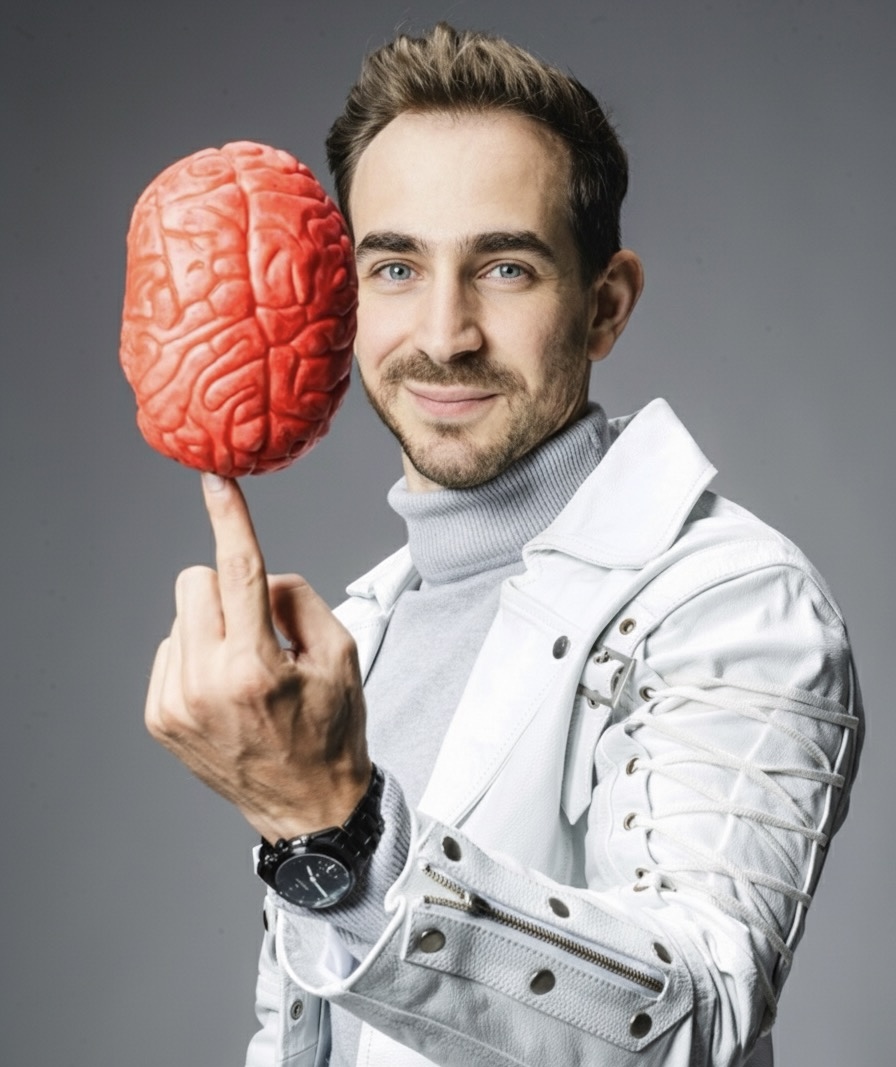
Neta Bresler, mentalist and perception researcher. Ranked 7th in the world in mentalism, featured on Netflix, performing and speaking for companies and conferences in Israel and abroad. Everything here comes from the stage, not the library.
More about Neta