Hiring a Trade Show Magician: Read This First
A mentalist who works exhibition floors explains what a trade show magician does to booth traffic, what he cannot fix, and how to brief one properly before day one.
7 min read
- Featured on Netflix
- Ranked 7th in the world in mentalism
- Shows and keynotes for companies
On this page
You have the stand booked, the graphics approved, and a nagging feeling that the three days are going to go the way the last three days went: your team standing in a row, looking available, while the aisle walks past at a steady four kilometres an hour.
So somebody in the meeting suggests hiring a trade show magician. And now you are reading this, trying to work out whether that is a clever idea or the kind of thing that ends with a man in a waistcoat pulling a sponge rabbit out of your CTO's jacket.
Fair question. Let me answer it properly, including the parts that do not help me.
What does a trade show magician actually change about booth traffic?
One thing, mostly. He converts walking into standing.
That sounds small. It is the whole game. Every lead your team gets starts with a human being deciding to stop moving, and on an exhibition floor that decision is made in about four seconds, against a few hundred other stands making the same bid for the same pair of eyes.
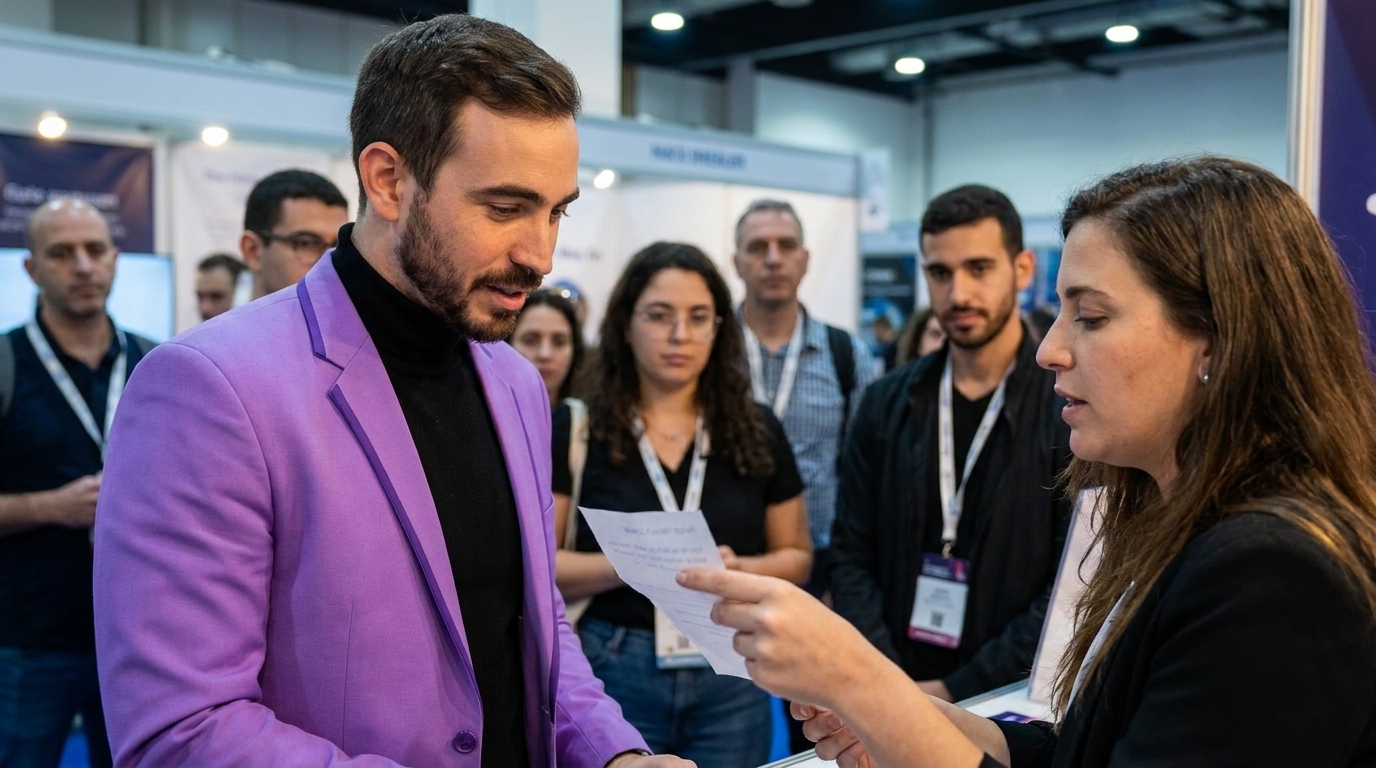
What a performer does is create a reason to stop that does not feel like being sold to. A person stops because something interesting is happening, not because somebody made eye contact and said "what brings you to the show?" (the single most defended-against question in the exhibition industry). Once they are standing, the physics change completely. A standing person will accept a conversation. A walking person will not.
The second effect, and I think the more valuable one, is that a crowd recruits a crowd. Eight people watching something is a visual anomaly on a floor where everyone is in motion. Attendees walk towards it without deciding to. I have had people tell me afterwards that they joined the group because they assumed something important was happening. That is not flattery. That is herd behaviour, and it is very reliable.
Why a mentalist rather than a card magician?
Because of what happens in the sixty seconds after the effect ends.
Card magic produces "how did you do that". Good feeling, dead end. The conversation that follows is about the trick, and your sales team has to pivot from a deck of cards to a cloud security platform, which is a long walk in a loud room.
Mentalism produces something else: a conversation about attention, about how people make decisions, about why a person chose the word they chose. That is already adjacent to almost every B2B product in the hall. If you sell fraud detection, behaviour analytics, UX tooling, insurance, anything that lives on human decision-making, the bridge is already built. I spend time with companies on exactly that overlap, and the handover from effect to product line is the part of the set I design last and rewrite most.
If you want the longer version of what the discipline involves in a theatre, I wrote about what the work looks like on a stage, and most of it transfers, minus the lighting and the silence.
How is a booth different from a stage?
Nearly everything is different, and this is where bookings go wrong.
- No start time. There is no curtain. The set begins when a stranger happens to glance over, which means the first fifteen seconds have to work with no context at all.
- No seats. People can leave at any moment and they will, mid-sentence, if their badge-scanning colleague wanders off. The material has to be built in short closed loops, not one long arc with a payoff at minute nine.
- Noise. An exhibition hall sits at a level where quiet, intimate pieces simply do not survive. Anything that needs a whisper is out before we start.
- Repetition. I will run the same core set perhaps twenty-five to thirty-five times across a day. It has to be built to survive that without decaying into a recitation.
A performer who is brilliant at a gala dinner and has never worked a hall will usually discover all of this on your stand, in real time, at your expense. Ask specifically how many exhibition days someone has worked. Not events. Exhibition days.
What will this not fix?
Here is the uncomfortable part.
A trade show magician moves people from the aisle to your carpet. He cannot move them from your carpet into your pipeline. That part belongs to your team, and if your team is not ready, I will hand you a crowd and you will watch it evaporate.
I have seen it. Twelve people standing, genuinely engaged, and three sales reps behind them looking at their phones because nobody told them the crowd was theirs. I now ask for a ten-minute briefing with the stand staff before day one, and I ask for one specific thing: a named person whose only job during each set is to stand at the edge of the group, ready to catch whoever turns around. Without that role, the performance is expensive decoration.
And a second honesty: if your goal is six deep technical conversations with named accounts you already have meetings with, do not hire me. You do not have a traffic problem. You have a scheduling problem, and a crowd on your stand will actively get in your way. I would rather say that now than invoice you for it later.
How do you brief a performer properly?
Give him three things, and give them early.
- The one sentence you want remembered. Not the positioning deck. One sentence. It gets woven into the material, not bolted onto the end like a disclaimer.
- The disqualifier. Who is walking past that you do not want? Students, job seekers, competitors scouting. Good material can quietly filter, and it is much easier than filtering at the badge scanner.
- The physical reality. Where the stand opens, where aisle traffic arrives from, whether you have a back wall or an island. I once rebuilt an entire set because traffic came from both directions, which means the stand has no "front" and no safe place to put my back.
If you are still shaping the stand itself, it is worth thinking about what makes people break stride in the first place before you decide where a performer stands inside it. The layout and the act are the same decision made twice.
What does a day on the floor actually look like?
Typically sets of eight to twelve minutes, with twenty to twenty-five minutes between them. The gap is not a break. It is when the stand staff work the people the set produced, and it is also the honest limit of a human voice in a hall that loud. By late afternoon on day two, that limit stops being theoretical.
Some clients want continuous presence instead: roaming the aisle, walking people back to the stand. That works, but it produces a different kind of lead, more volume and less depth. Pick one deliberately rather than discovering which one you bought on day two.
And if your show includes a theatre slot or a stage session on the programme, that is a separate conversation with separate material, closer to what I do as a keynote speaker than to anything that happens on a carpet. Same for an evening client dinner, where a mentalist show is a different build again.
So the decision in front of you is not really whether to book a performer. It is this: when twelve strangers are standing on your stand at 11:40 on a Tuesday, who, by name, is going to talk to them?
If you can answer that, the rest of this is easy. If you cannot, fix that first. It is cheaper, and it works even if you never hire anyone.
Questions people ask
How many hours a day can a performer work a stand?
Realistically six to seven hours of floor presence, broken into sets of eight to twelve minutes with twenty to twenty-five minutes between them. That adds up to roughly twenty-five to thirty-five sets. The limiting factor is not energy, it is the voice: a hall that loud forces you to push, and pushing for three straight days has a cost that shows up on day two.
Do we need a microphone or a sound system on the stand?
Usually not, and often it is worse. A PA on a stand competes with the PA next door and irritates your neighbours by lunchtime on day one. The set is built so the first row hears clearly and the back row leans in, which is itself part of the effect. If your venue limits stand audio, tell me before the material is built, not after.
Can the performance mention our product directly?
Yes, and it should, but as one woven sentence rather than a pitch at the end. Give me the single claim you want people repeating in the taxi. I build the handover around it so the crowd walks into a conversation already half started. A full product explanation inside the set kills the crowd and makes the next set harder to gather.
What size stand does this need?
Three by three metres is workable if you have aisle space in front and nothing fragile at knee height. Below that, the crowd blocks your own entrance and your staff cannot reach anyone. An island stand with traffic from several directions needs different material entirely, because there is no reliable place to face. Send a floor plan early and I will tell you honestly if it fits.
Is this suitable for a technical or regulated industry audience?
Often better suited than you would expect. Engineers, risk teams and compliance people tend to engage harder because the material is about decision-making rather than spectacle. The one constraint worth naming in advance: if your sector forbids gifts, prizes or data capture during entertainment, say so at briefing stage so the set does not rely on anything you cannot hand out.

Who writes here
Neta Bresler, mentalist and perception researcher. Ranked 7th in the world in mentalism, featured on Netflix, performing and speaking for companies and conferences in Israel and abroad. Everything here comes from the stage, not the library.
More about Neta