Mentalist for Corporate Events: Three Different Jobs
A mentalist can work your booth, your cocktail hour, your stage or your keynote slot. Four different jobs, four budgets, and how to tell which one your event needs.
9 min read
- Featured on Netflix
- Ranked 7th in the world in mentalism
- Shows and keynotes for companies
On this page
- What does a mentalist do at a trade show booth that a hostess cannot?
- Does strolling mentalism work at a cocktail hour or a networking reception?
- Is a mentalist the right thing for a gala dinner or an awards night?
- What is the difference between a mentalist show and a mentalist lecture?
- How do I brief a mentalist so the content fits my company?
- So which one do you actually need?
You have a corporate event on the calendar, somebody in the meeting said "let's get a mentalist", and now you are the one holding the budget line and the question. Which is fair. The hard part is that mentalist for corporate events describes at least four completely different jobs, and booking the wrong one is how you end up with a perfectly good performer standing in a very wrong room.
I do all of them. Exhibition floors at Expo Tel Aviv, conference halls around Airport City, hotel ballrooms in Eilat during the season when half the country's sales kickoffs happen in the same week. The clients are mostly the sectors you would guess: fintech, cybersecurity, insurance, pharma, a lot of hi-tech companies who have flown in a regional team and have one evening to make it feel worth the flight.
The jobs share a skill set and almost nothing else. The room is different, the goal is different, the cost is different, and the way you measure whether it worked is different.
So before anything else: what is the event actually for?
What does a mentalist do at a trade show booth that a hostess cannot?
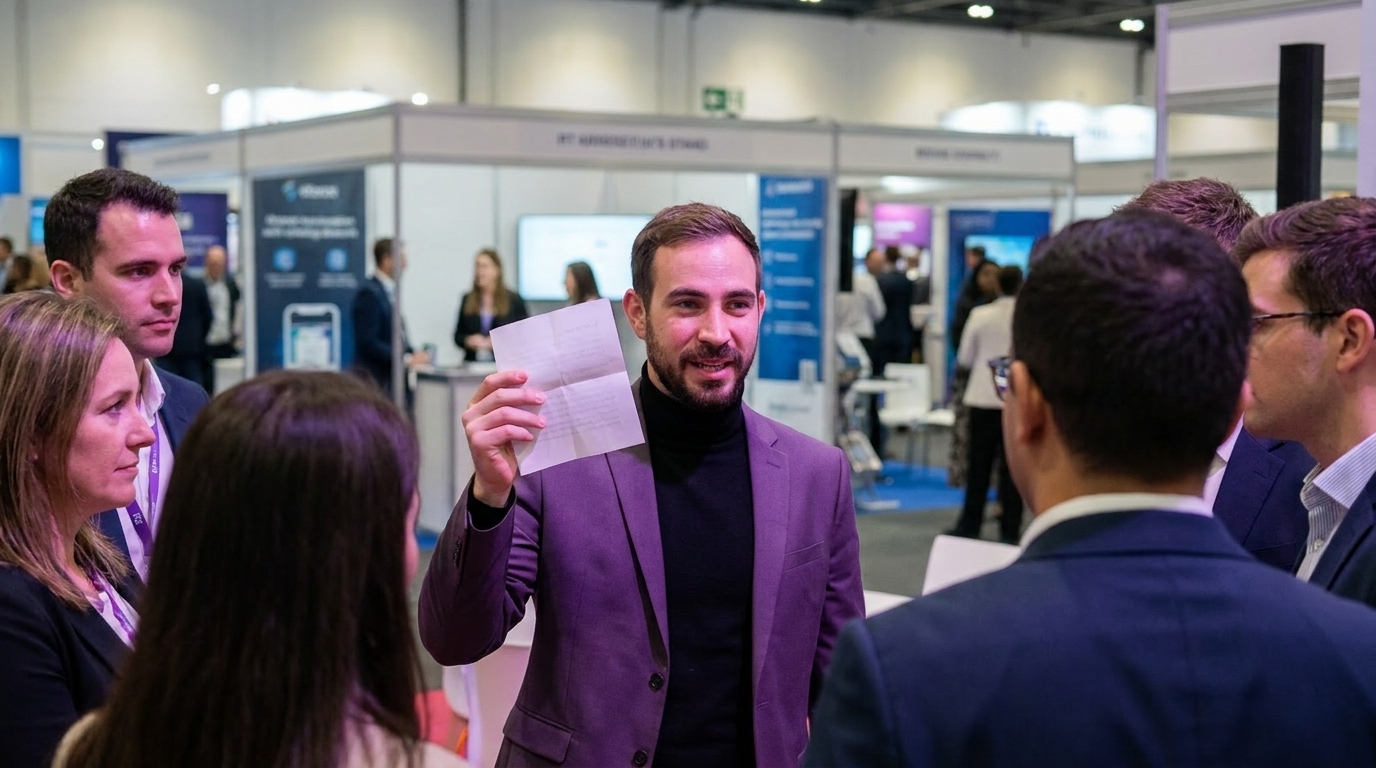
At an exhibition, your problem is not persuasion. Your problem is four seconds of peripheral vision. People walk the aisle at a steady pace, scanning on autopilot, and your stand gets a fraction of a glance before the decision to keep walking has already been made.
A hostess with a flyer confirms what the visitor already predicted about your stand. A trade show magician breaks the prediction. Something happens that the walking brain cannot file, and the feet stop before the person consciously decides to stop.
That is the whole mechanism. Everything after it is yours.
Practically, a booth day runs in cycles. Roughly 8 to 12 minutes of performance, then a gap while the group I just gathered talks to your salespeople, then the next cycle. Across a six-hour exhibition day that is somewhere between 15 and 20 sets, not six hours of continuous performing (nobody can do six hours of continuous performing, and anyone who promises it is describing a man slowly dying on his feet).
The part most companies get wrong is the handover. I can stop 25 people and hold them. I cannot qualify them, I cannot scan their badge, and I will not pitch your product in a voice that sounds like I believe it more than your own team does. If your stand is staffed by two people who are both on their phones when the crowd forms, the crowd disperses and you paid for applause. I have written more about what actually makes people stop at a stand, but the short version is that stopping is the cheap part.
Does strolling mentalism work at a cocktail hour or a networking reception?
This is the format most people forget exists, and for a mixed reception it is often the right answer.
Strolling mentalism, sometimes called close-up, means no stage, no microphone, no running order. I move between small clusters of guests, work for three to six people at a time, five minutes or so, then move on. Over a 90 minute reception that is somewhere between 15 and 25 groups, which usually covers a room of 120 to 200 people without anyone being asked to sit down or stop talking.
It solves a specific problem. The first hour of most corporate evenings is socially awkward: people arrive in the clumps they came with, the regional team stands with the regional team, and nobody crosses the room. Close-up work mixes that, because a group that has just watched something impossible immediately turns to the people next to them to confirm they also saw it. I have watched strangers from two departments argue about a chosen word for ten minutes after I left the circle.
When it is wrong: when the room is under about 40 people (just do a short seated set, everyone can see), and when the client wants a single shared moment that the whole company talks about afterwards. Strolling gives you 20 small memories. A stage gives you one big one.
Is a mentalist the right thing for a gala dinner or an awards night?
Sometimes. It depends entirely on where it sits in the running order.
A mentalist show at a corporate evening works when the audience is seated, facing one direction, with nothing being served. It works badly during main course. It works badly when there is an open bar behind the audience and a DJ booth being tested at the side of the room.
Here is the thing I will say against my own interest: if your plan has me performing for 45 minutes while waiters move between tables, do not book me. Book a band. A band survives a room that is only half listening, because music is built to work as background. Mentalism is not. It depends on a group of people all noticing the same small impossible thing at the same moment, and a plate arriving at table nine kills that moment for eleven people.
I would rather turn down the booking than take the fee and deliver a compromised version. I have had that conversation with producers more than once, and about half the time the fix is simple: move the show to after dessert, 25 minutes, lights slightly down. Same budget, entirely different evening.
What is the difference between a mentalist show and a mentalist lecture?
A show is built around wonder. A lecture is built around transfer.
When I am booked as a keynote speaker, the demonstrations are still there, but they function as evidence rather than entertainment. I work with a framework I call קופס"א: attention, certainty, wonder, story, belief. Five stages that describe how a person travels from noticing something to being convinced of it, in that order, and the order almost never changes.
Why would a sales team or a product team care? Because the same sequence that lets me convince a volunteer they chose a card freely is the sequence a phishing email uses, the sequence a good onboarding flow uses, and the sequence your competitor's deck is running on your customer this afternoon.
I have consulted with companies on fraud prevention and behaviour analytics, and the recurring finding is uncomfortable: people are not deceived because they are careless. They are deceived because the deception arrived in the right order. If you want the longer version of what that slot looks like, I set out the shape of a keynote slot separately.
How do I brief a mentalist so the content fits my company?
Less than you think, and more specifically than you think.
What I need is not your brand deck. What I need is:
- Who is in the room. Engineers and salespeople react to different things, and I would rather know in advance than discover it in minute three.
- The one sentence you want people repeating in the car on the way home.
- Any name, product or number that genuinely matters. One or two, not nine.
- The honest noise level and sightlines of the space, including where the bar is.
- Whether anyone in the room outranks everyone else, and whether they enjoy attention or would quietly murder me for pointing at them.
That last one has saved more events than any piece of staging. A CEO who hates being volunteered is a known risk, and I would rather handle it than find out live.
What I will not do is wrap your messaging into the effects so tightly that the performance becomes an advertisement. The audience notices immediately, the wonder collapses, and you are left with a commercial that cost more than a commercial. A light touch lands harder. If you want to see inside the craft itself, the mechanics of the stage work are laid out elsewhere on this site.
So which one do you actually need?
On budget, because somebody has to say a number out loud. In the Israeli corporate market, a single evening stage set of 25 to 40 minutes typically sits in the range of roughly ₪6,000 to ₪15,000, depending on length, travel, technical requirements and how far into the night the slot falls. A 90 minute strolling or close-up reception usually lands in a similar lower band. A full exhibition day, which is the physically hardest of the formats, generally runs higher, in the region of ₪10,000 to ₪20,000 per day, and multi-day stands are usually quoted as a package rather than a multiple. A keynote slot with custom content and preparation sessions is priced on the preparation, not the stage time. Treat these as orientation rather than a quote (every event has one detail that moves the number, and it is usually the get-in time or the flight).
Now the decision, and it is yours to make before you contact anybody.
If success is measured in conversations started, you want booth work, and you need to staff for the crowd you are about to create. If it is measured in how the room felt and how quickly strangers started talking, you want strolling. If it is measured in how the evening felt as one shared moment, you want a stage show, and you need a seated, fed, quiet audience. If it is measured in what people do differently on Monday, you want a lecture, and you need 40 minutes that nobody is allowed to schedule over.
Pick the measurement first. The brief writes itself after that, and the conversation with whoever you hire gets about three times shorter.
Which of those is your event really being judged on? Once you can answer that in one sentence, send it to me along with the date and the room, and I will tell you honestly whether what you need is me, a band, or a better running order.
Questions people ask
How far in advance should we book a mentalist for a company event?
For the busy stretches, meaning the weeks around the Jewish holidays and the January to March kickoff season, four to eight weeks is realistic and earlier is safer. Outside those windows I have taken bookings with ten days' notice. The constraint is rarely my diary, it is whether there is enough time to get the brief and the running order right before the room fills..
Can the performance be done in English for an international team?
Yes. I work in both Hebrew and English, and for mixed rooms English is usually the better choice even when most guests are Israeli, because switching mid-show costs you the shared moment. Tell me the language split in advance. If more than about a quarter of the room is non-Hebrew speaking, I will recommend running the whole set in English.
What technical setup do you need from the venue?
For a stage set: a wireless handheld or headset microphone, a lit area of about three metres by two, and the ability to bring house lights down slightly. For strolling, nothing at all. The one request I will push on is sightlines, because if the back third of the room cannot see the volunteer's face, they stop believing in the volunteer.
Will you single out senior people from the audience?
Only if you tell me it is welcome. Tell me in the brief who outranks everyone else and how they feel about attention, and I will either build a moment around them or route carefully around them. A CEO who hates being volunteered is a solvable problem in advance and an unsolvable one at minute four.
Can you combine two formats at the same event?
Often, and it is usually the best value for a full evening. A common shape is 60 to 90 minutes of strolling during the reception, then a 25 minute seated set after dessert. The limit is physical and vocal stamina, so I will not stack a full exhibition day and an evening show on the same date.

Who writes here
Neta Bresler, mentalist and perception researcher. Ranked 7th in the world in mentalism, featured on Netflix, performing and speaking for companies and conferences in Israel and abroad. Everything here comes from the stage, not the library.
More about Neta