Corporate Magician: What You Are Actually Buying
What a corporate magician changes at a booth, a banquet or a cocktail hour, how sets are timed, typical fee ranges, and when the honest answer is don't hire one.
10 min read
- Featured on Netflix
- Ranked 7th in the world in mentalism
- Shows and keynotes for companies
On this page
- What are the different kinds of corporate magic, and which one fits my event?
- How much does a corporate magician cost?
- What does a magician actually change at a trade show booth?
- Is a magician the same thing as a mentalist for this kind of work?
- How long is each set, and how many can one person do in a day?
- What should the magic actually say about our product?
- When should we not hire you for this?
- How do we brief this properly?
- So what do you decide now?
You have an event in nine weeks, a budget line that says "entertainment", and a vague memory of a stand you walked past last year where thirty people stood in a semicircle while your own booth had a bowl of mints and one very patient salesperson. Or maybe it is a holiday dinner for 180 people and the thought of another DJ makes you tired. So you typed "corporate magician" into a search bar, and now you are here, trying to work out whether that is a serious solution or a slightly embarrassing one.
Fair question. Let me answer it the way I would if you called me.
What are the different kinds of corporate magic, and which one fits my event?
They are not variations on one act. They are three different jobs that happen to use overlapping skills.
- Strolling (close-up) work. Cocktail hours, welcome receptions, the awkward forty minutes before dinner is served. I move between standing groups and perform three to five minutes per group, no stage, no sound system. The job here is social lubricant: breaking up clusters of people who already know each other so they talk to someone new.
- Stage work for a seated room. Banquets, awards nights, year-end dinners, sales kickoffs. One set of 35 to 50 minutes, a microphone, a light on me and not on the dessert. This is the version where the whole room shares one experience, and it needs a real stage moment in the running order, not a slot while waiters clear plates.
- Booth work at an exhibition. Short repeated sets, standing crowds, a noisy hall. A completely different rhythm, which I will get to, because it is the format people most often brief wrongly.
There is a fourth request I get regularly: team building. I am honest about it. I can run a session on attention, suggestion and how people are fooled, and it tends to land well with sales and security teams, but it is a keynote speaker brief dressed in different clothes, not a party trick with a worksheet. If you want trust falls, I am the wrong call.
Most of my seated-room work comes in as a corporate magician booking for an evening with a defined audience and a defined slot. Everything below about booths assumes the opposite: nobody is seated, nobody committed to watching, and everyone is walking somewhere else.
How much does a corporate magician cost?
I will not quote you my own fee on a public page, because it depends on date, travel and how many hours of performance you actually need. But you deserve a range to budget against, so here is what the market looks like.
In Israel, a single evening of stage mentalism for a corporate audience typically sits somewhere between 4,000 and 15,000 shekels depending on the performer's profile and the length of the set. Strolling work for a reception is often lower, roughly 3,000 to 8,000 shekels for two hours. International bookings, where flights, a hotel and two travel days come into it, usually start around 3,000 to 5,000 US dollars and go up from there. Multi-day exhibition work is quoted per day, and the per-day figure drops when it is three days rather than one, because the travel is already paid for.
Two cost drivers that surprise people: a Saturday night in December costs more than a Tuesday in March (every performer's diary works this way), and a second set on the same evening costs far less than the first one.
What does a magician actually change at a trade show booth?
One thing, mostly: the decision to stop walking.
That is the whole bottleneck at an exhibition. Your messaging is fine. Your product is probably better than the one three aisles over. But a person moving down a hall at normal walking speed gives your stand somewhere between one and two seconds of consideration, and in that window they are not reading your headline. They are scanning for a reason not to be interrupted.
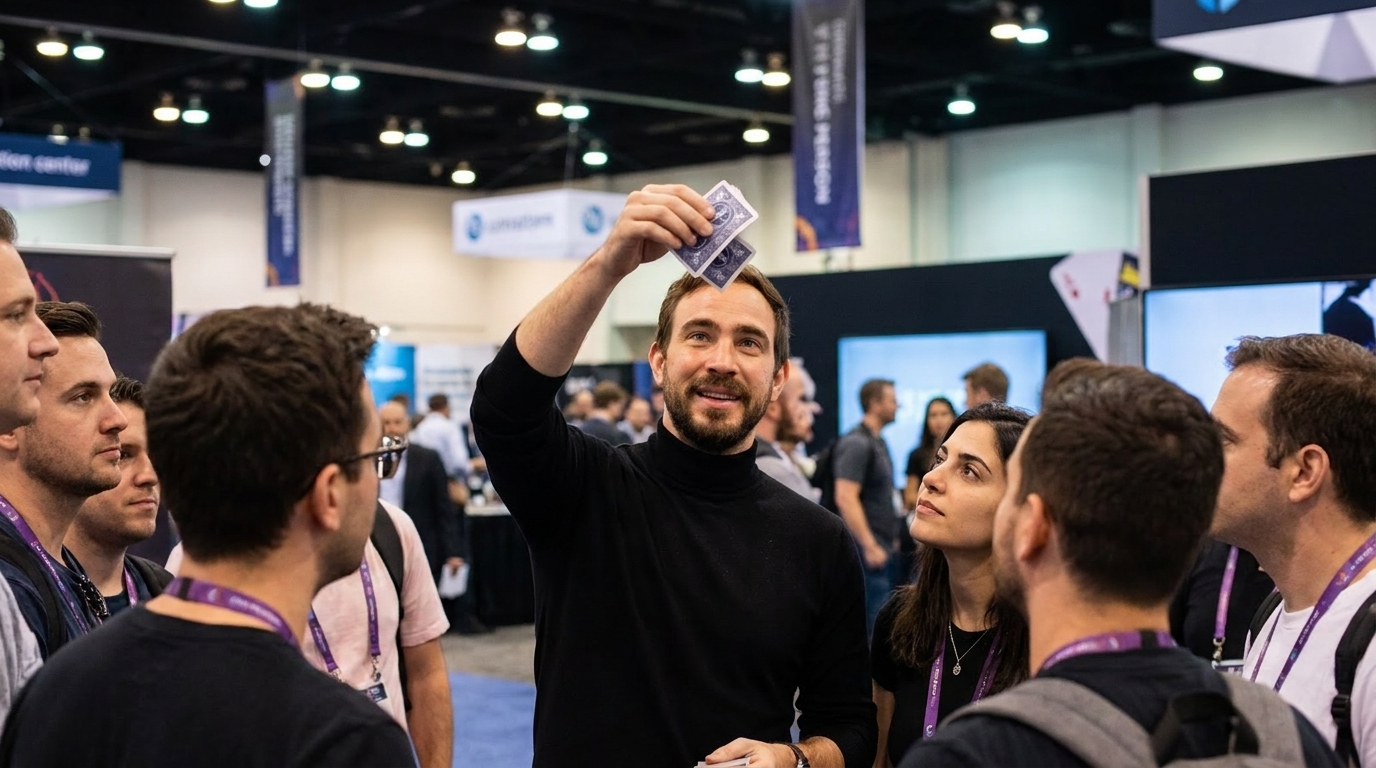
A good booth act removes that reason. Not by shouting, and not by blocking the aisle (I have seen performers do both, and both make a stand feel like a timeshare pitch). It works because a small group of people standing still and laughing is the most reliable attention magnet in a convention centre. Humans look at what other humans are looking at. That is not a theory I invented, it is just how crowds behave, and it is the mechanism you are renting.
The second thing it changes is harder to see on the day. People remember the stand where something happened to them. A week later, when your sales team follows up, the email lands next to a memory instead of next to nothing. I cannot put a number on that lift and I will not pretend to.
Is a magician the same thing as a mentalist for this kind of work?
At a booth the difference matters less than you think and more than nothing.
I work as a mentalist. The material is built around thought, choice, memory and perception rather than around objects appearing and vanishing. In a crowded hall that has one real advantage: the effects happen inside the visitor's head, so nobody needs a clean sightline to a small prop. Someone standing three rows back can still follow "he knew the word she was thinking of." They cannot always follow a coin.
If you want the longer version of the discipline, I wrote about what the work looks like on a stage rather than at a stand.
How long is each set, and how many can one person do in a day?
This is where most planning goes wrong, so here are my real constraints.
- A booth set runs 6 to 9 minutes. Long enough for a crowd to form and for one strong moment to land. Shorter and nobody commits to stopping. Longer and your sales team is standing behind a wall of spectators who have no intention of buying anything.
- 45 minutes on, 15 minutes off, roughly. Inside the 45 I run sets back to back with short gaps so the crowd clears and your team can speak to the three or four people worth speaking to.
- Four to five hours of performing per day is the honest ceiling. Six is possible once. Across a three day show it is not, and the quality on day three is what everyone remembers.
- Set-up needs a square metre or so of clear floor and a surface at waist height. No stage, no screen, and usually no microphone (a mic on a booth annoys your neighbours and sometimes breaches the organiser's noise rules, which are worth reading before you promise anyone anything).
I also ask for a fifteen minute briefing with whoever is actually working the stand, on the morning of day one. Not for my benefit. The handover from "crowd is laughing" to "salesperson starts a conversation" is the part that fails, and it fails because nobody agreed in advance who steps forward and when.
What should the magic actually say about our product?
Something, but less than your marketing team will want.
The usual request is a routine built around the product itself. Sometimes that works beautifully. More often it produces a sketch that is neither good magic nor a clear message, and the audience quietly files it under "advertisement" and leaves. What works better: the act earns attention honestly, and then one clean sentence carries your positioning at the moment people are most receptive, which is the two seconds after the effect lands and before anyone has started walking again.
I have worked with companies in fraud prevention and behaviour analytics where the fit was unusually natural, because deception and attention are literally the subject matter. If your product is a payroll integration, we will find a line, but I am not going to make the payroll the trick.
If you are still shaping the stand itself, some of the structural thinking is in this piece on booth ideas that actually stop people, and a lot of it costs nothing.
When should we not hire you for this?
Three cases, and I would rather say them now than in week eight.
Don't hire me if your booth is under about 9 square metres and tucked into a corner. A crowd needs somewhere to stand that is not the aisle. In a tight corner stand I become a traffic obstruction, the floor manager comes over, and you have paid for a problem.
Don't hire me if the goal is lead qualification. I generate stopping power and goodwill. I do not pre-qualify, I do not scan badges, and I am not a substitute for having enough people on the stand. A performer in front of two overwhelmed salespeople makes the bottleneck worse.
Don't hire me if what you want is background atmosphere. Magic as wallpaper is a waste of the format. If you want ambient pleasantness, hire a good coffee cart. Genuinely. It will do the job better and cost less.
And if what you need is an hour of content on the main conference stage rather than traffic at a stand, that is a different brief with a different shape. There is more on the distinction in my notes on what a keynote slot involves.
How do we brief this properly?
Three pieces of information, in this order, tell me whether the job is possible before we talk about anything else.
- The hall and stand number, plus the floor plan, or for an evening event the venue and the running order. I want to see where attention enters the room.
- How many of your people are working, per shift. This is the number that decides whether an act helps you or drowns you.
- What a win looks like. Conversations, demo bookings, a memorable evening for a team that has had a hard year. These lead to very different sets.
Most of my exhibition work comes in as a trade show magician brief for two or three day events, and the bookings that go well are almost always the ones where that third question had a real answer.
So what do you decide now?
Not whether to book anyone. Decide this instead: look at your plan and find the square metre where a group of eight people could stand without blocking anything. At a booth it is floor space. At a dinner it is a moment in the running order where the room is not eating.
If that space exists, send me the floor plan or the evening's schedule along with your date, and we can work out in one conversation whether the format fits. If it does not exist, no performer on earth will fix it, and the honest move is to spend the money on the layout instead.
Which one is it on your plan?
Questions people ask
Can one performer cover both our booth during the day and the evening dinner?
Sometimes, but it should be planned as two jobs. Four to five hours of booth sets already uses up the day, and a 35 to 50 minute stage set that night needs voice and energy left over. If the dinner matters more than the booth, I cut the exhibition hours to about three and we protect the evening.
Do you need a stage, sound or lighting for a seated corporate event?
For a room of roughly 80 people or more I need a wireless microphone and a light on me rather than on the tables. No screen is required, though for audiences above about 250 a camera feed helps. Strolling work at a cocktail hour needs nothing technical at all, just normal room lighting.
Will you perform in English, Hebrew, or both?
Both, and I will confirm which before the date rather than switching mid-set. Mentalism leans on precise wording, so a mixed-language room is a real design decision: I usually pick one language for the spoken material and choose participants who are comfortable in it, instead of translating as I go.
How far in advance should we book?
For a December or June evening, two to three months is sensible, because those weeks fill first in every performer's diary. Exhibition work can sometimes be arranged in three or four weeks if travel is simple. What I cannot compress is the briefing: I want fifteen minutes with your team before the first set.
Can the performance be built around our product launch?
Partly. A routine built entirely around the product usually reads as an advertisement and the audience switches off. What works is honest attention first, then one clean sentence carrying your message in the seconds after the strongest moment. Send me your positioning line and I will tell you straight whether it can carry that weight.

Who writes here
Neta Bresler, mentalist and perception researcher. Ranked 7th in the world in mentalism, featured on Netflix, performing and speaking for companies and conferences in Israel and abroad. Everything here comes from the stage, not the library.
More about Neta