Exhibition Stand Ideas, Judged by the Aisle
Exhibition stand ideas tested from inside the booth: which design choices stop walking traffic, which only photograph well, and how to choose by your lead goal.
10 min read
- Featured on Netflix
- Ranked 7th in the world in mentalism
- Shows and keynotes for companies
On this page
- What do I do with my exhibition stand if the space is small?
- Which exhibition stand ideas actually stop someone walking past?
- Which design choices help, and which only photograph well?
- Are giveaways, games and prize wheels worth it?
- Should I hire a performer at the booth, and what changes?
- When is hiring someone like me the wrong idea?
- What does booth work cost, and how does booking work?
- What to check before you book booth entertainment
Have you ever stood at your own booth on day two, coffee going cold, watching people walk straight past the thing you spent months designing?
I have watched that from about a metre away, from inside the stand. That is my work. I get hired to gather a crowd in an aisle and hand talking, interested humans to the sales team. So my view of exhibition stand ideas is a bit skewed: I care less about how the stand looks in the renders, and more about what it does to a person walking at speed with a bag on their shoulder and another hall to cover before lunch.
Here is how I sort the ideas. Not by budget. By what the idea is actually supposed to achieve.
What do I do with my exhibition stand if the space is small?
Small stands usually fail for one reason: the owner tries to fit a big stand's thinking into a small footprint. Product pedestals, a meeting table, a branded wall, a screen loop, a brochure rack. Now your staff are furniture, and nobody can stand still in front of you without blocking the aisle.
On a small footprint I would pick one thing to be the stand's whole personality. A single product with nothing around it. A wall that is empty except for one sentence, in letters readable from the far side of the aisle. Or a person doing something with their hands that people can see from a distance.
The hard part of a small stand is not design. It is deletion.
One thing worth checking before you order anything: the aisle width on the hall's own floor plan, and what the organiser allows in front of your frontage. If your aisle is narrow, you want a crowd that forms wide and shallow, along your edge, rather than deep and spilling into the walkway. Hall staff will tell you about the difference by the afternoon, and they will be right.
Which exhibition stand ideas actually stop someone walking past?
Only a few things reliably interrupt a person in motion, and they are all a bit primitive.
- Motion at head height. Not a screen. Physical movement, made by a human.
- Other people's attention. People stop where people have stopped. The first few are expensive to gather. The ones after them are nearly free.
- Something visibly unfinished. A half-built thing, a sentence with a blank in it. Open loops pull.
- Being addressed as a person rather than as traffic. "Can I show you something quick" works. "Would you like to hear about our platform" does not, and you know it does not, because you dodge it yourself in every other hall.
I wrote a longer version of this from the floor in field notes on attracting people to a trade show booth. Here I want to stay on the choosing.
Which design choices help, and which only photograph well?
Most inspiration you will be shown was photographed empty, at night, by someone on a ladder. Your visitors never see that view. So here is how the usual ideas behave once there are bodies in the hall.
Lighting. Underrated, and it survives a bad hall position. Overhead hall light is flat and grey. A few focused spots make a bright patch the eye finds from distance. Light the thing you want people to walk towards, and light faces, because a lit face reads as activity from much further away than any text on your wall.
Height. A hanging sign tells people across the hall that you exist. That is wayfinding, not attraction. I have stood under some very expensive towers while nobody came in. Budget it as a map, not as a magnet.
Open versus closed layouts. A counter across the front performs like a shop with the shutter half down. Every barrier between the aisle and a human adds a decision the visitor has to make. Keep the front strip of your footprint deliberately empty. That is where a crowd forms, and a crowd that forms inside your stand is not blocking the walkway.
Flooring. It looks like a line item you can cut. It is one of the few elements people feel rather than see. A raised floor or even a colour change at the boundary registers as crossing a threshold, and people who have stepped onto something tend to stay.
Zoning. On anything larger than a corner booth, draw three areas before anything else: where strangers gather, where a real conversation happens, and where your team can sit down with water for a few minutes. Skip the third and by late afternoon they will be doing their hiding in full view of visitors.
Are giveaways, games and prize wheels worth it?
It depends entirely on what you are measuring.
A prize wheel will produce a queue and badge scans. It will also produce a specific visitor: the collector. If your metric is scan count, you will have a magnificent day. If your metric is qualified conversations, you may be holding records your sales team quietly deletes months later.
Games are not the problem. Games with no relationship to the product are. A basketball hoop tells a visitor that you had a basketball hoop. My honest opinion, from standing in these halls: visitors are tired of giveaways and want an experience, and wonder that carries your message is remembered together with the product.
Should I hire a performer at the booth, and what changes?
What a performer changes is the rate of stopping. Good staff convert people who were already going to stop. A performer manufactures the stopping.
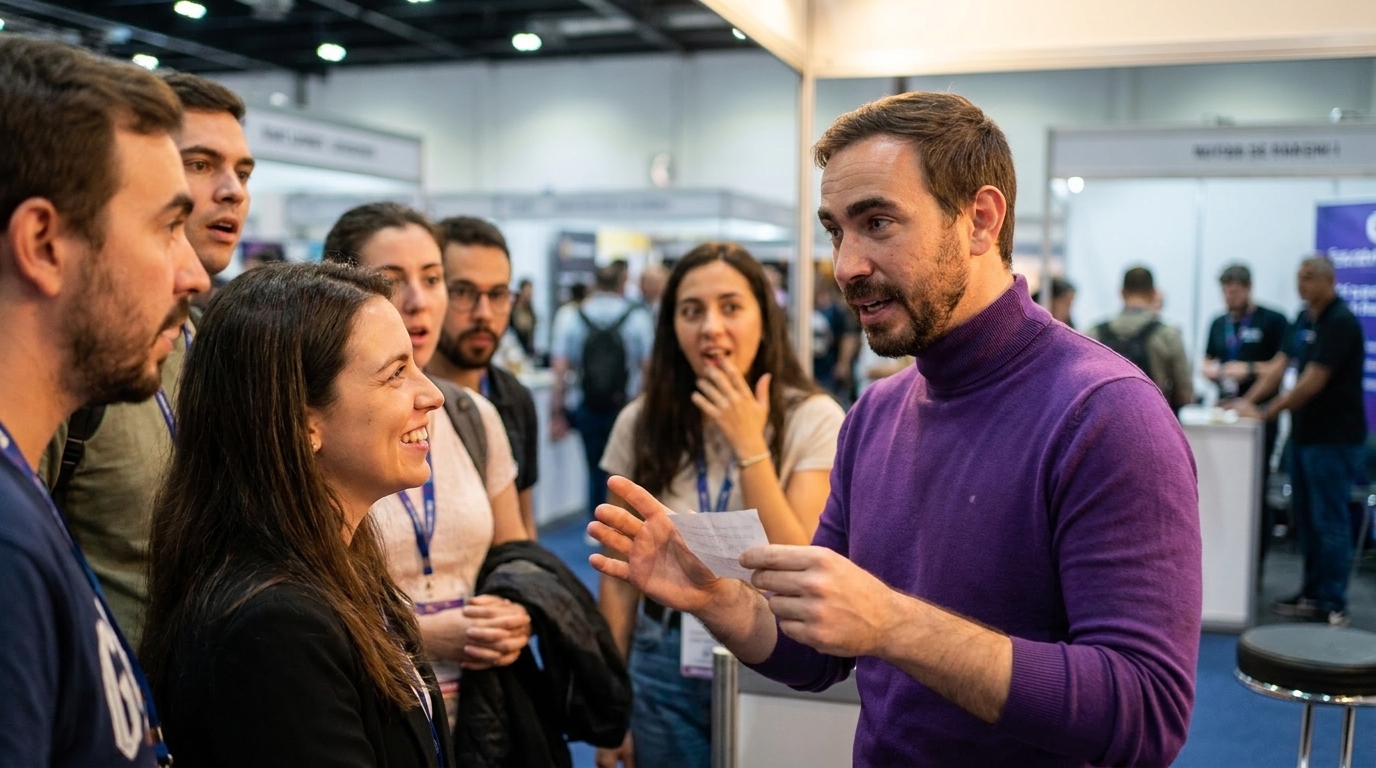
The way I work it is simple and a bit stubborn. I start with one visitor. I make that one person laugh and clap, and the noise pulls the next few, and the crowd builds from there. A magnet that magnetises more people, as I describe it to clients.
The thing I most need from you before the show is your marketing message, because I build it into the magic. During the trick I ask questions that check, against criteria you give me, whether this visitor is a relevant lead, I pass on points about the product, and I finish with a question that hands the visitor to your sales reps.
I do not close sales. A visitor, a relevant lead and a paying customer are three different things, and I only work on the first two. When a company books me as a trade show magician for booth traffic, the handover is the actual product; the effect is the bait.
Extras we have built before, with no client named: a lead form on a site with a small trick inside it, cards carrying a QR code to a lead form, and a selfie taken during a trick that the company attached to its follow-up email ("remember us from the conference?").
Practically, I need a comfortable spot to perform and draw people. Amplification is recommended. I can bring my microphone; the PA system comes from you.
When is hiring someone like me the wrong idea?
Two cases I would rather say now than after a contract is signed.
If your stand is a meeting stand. Some exhibitors do not want footfall at all. They have pre-booked meetings with named accounts and a closed room. A crowd in the aisle actively harms that. Do not hire me. Hire better coffee.
If your team is very small or untrained. I can gather people faster than a skeleton crew can talk to them, and then you have paid for a bottleneck. Spend the money on briefing instead, so every person on the stand can say in one sentence what the company does and ask one good question back.
Some exhibitors also have a speaking slot in the conference attached to the fair and treat it as an afterthought. A room of your buyers, sitting down, is a strong asset; filling it with your own expert or an outside keynote speaker on attention and belief design often moves more than another square metre of carpet. I wrote about that attention problem in a piece on keynote speaking in Las Vegas. If the evening programme is the part you are worried about, that is the mentalist show for corporate events, a different brief entirely, and I never carry one service's promises into another.
What does booth work cost, and how does booking work?
I will not put a figure on a page, because the number genuinely depends on the service you want, its format, how much personalisation we build in, any extras like branded cards or Polaroids, the place and the date.
The path is short: an enquiry through the site, a conversation with Ori, my personal manager, who works out the details and which product actually fits, then a quote and a contract (usually with a deposit). There is no minimum lead time, though booking early is how a date stops being available to someone else.
What to check before you book booth entertainment
- The one marketing message you want built into the magic, written in a single sentence.
- Your criteria for a relevant lead, so the qualifying questions are yours and not my guesses.
- Who on the stand takes the handover when I turn a visitor towards them.
- Where I can stand comfortably to perform and gather people, on your floor plan.
- Amplification: I can bring a microphone, you bring the PA system.
- Whether you want extras prepared in advance, such as branded or custom cards, QR cards or Polaroid souvenirs (these carry an additional cost).
- Language: I work in Hebrew and English only.
For context on whether this is my world at all: I competed at the FISM World Championship of Magic in Quebec in 2022 in the mentalism category, and I appeared on Netflix in Squid Game: The Challenge. The rest of my evidence is in halls, which photograph badly.
So, which of your current exhibition stand ideas can actually produce the conversations you need, with the people you are really bringing?
If the honest answer is "none of them yet", that is a fine place to start a conversation. Send the date, the place and how many visitors you expect, through the contact form or the WhatsApp link on the booth traffic page, and Ori will take it from there. I have talked exhibitors out of booking me before, and nobody complained afterwards.
Questions people ask
Can a performer work on a small exhibition stand?
Usually yes, as long as there is a comfortable spot where I can stand and gather people without pushing the crowd into the aisle. On a narrow footprint the crowd should form wide and shallow along your frontage. Check your hall's floor plan for aisle width and what the organiser allows in front of your stand before you commit to a layout.
How do you make sure the people you gather are relevant to us?
You give me the criteria that define a relevant lead for your company. During the trick I ask questions that check against those criteria, pass on points about the product, and end with a question that hands the visitor to your sales reps. I do not close sales. A visitor, a relevant lead and a customer stay three separate things.
What equipment do you need at the booth?
A comfortable place to perform and draw people. Amplification is recommended in a loud hall, and I can bring my microphone, while the PA system comes from the exhibitor. Anything you want branded or prepared in advance, such as custom cards, QR cards or Polaroid souvenirs, is an optional extra at additional cost and needs to be agreed before the show.
How far in advance should we book?
There is no minimum lead time, but booking early is the only way to keep a date from going to someone else. A date is held for a limited time until the contract is signed. The route is an enquiry through the site, a call with Ori, my personal manager, then a quote and a contract, usually with a deposit.
Do you work outside Israel?
Yes, I perform anywhere in Israel and abroad, in Hebrew and English only. For an international show, the date, the place and the show language are the first three things to send, since they affect both scheduling and the quote. Ori handles the details and will tell you what is possible for your dates.

Who writes here
Neta Bresler, mentalist and perception researcher. Ranked 7th in the world in mentalism, featured on Netflix, performing and speaking for companies and conferences in Israel and abroad. Everything here comes from the stage, not the library.
More about Neta