Book a Keynote Speaker Without the Email Loop
Book a keynote speaker in days, not weeks: what to put in the first message, what moves the fee, bureau versus direct, what locks a date, and when a talk is the wrong hire.
11 min read
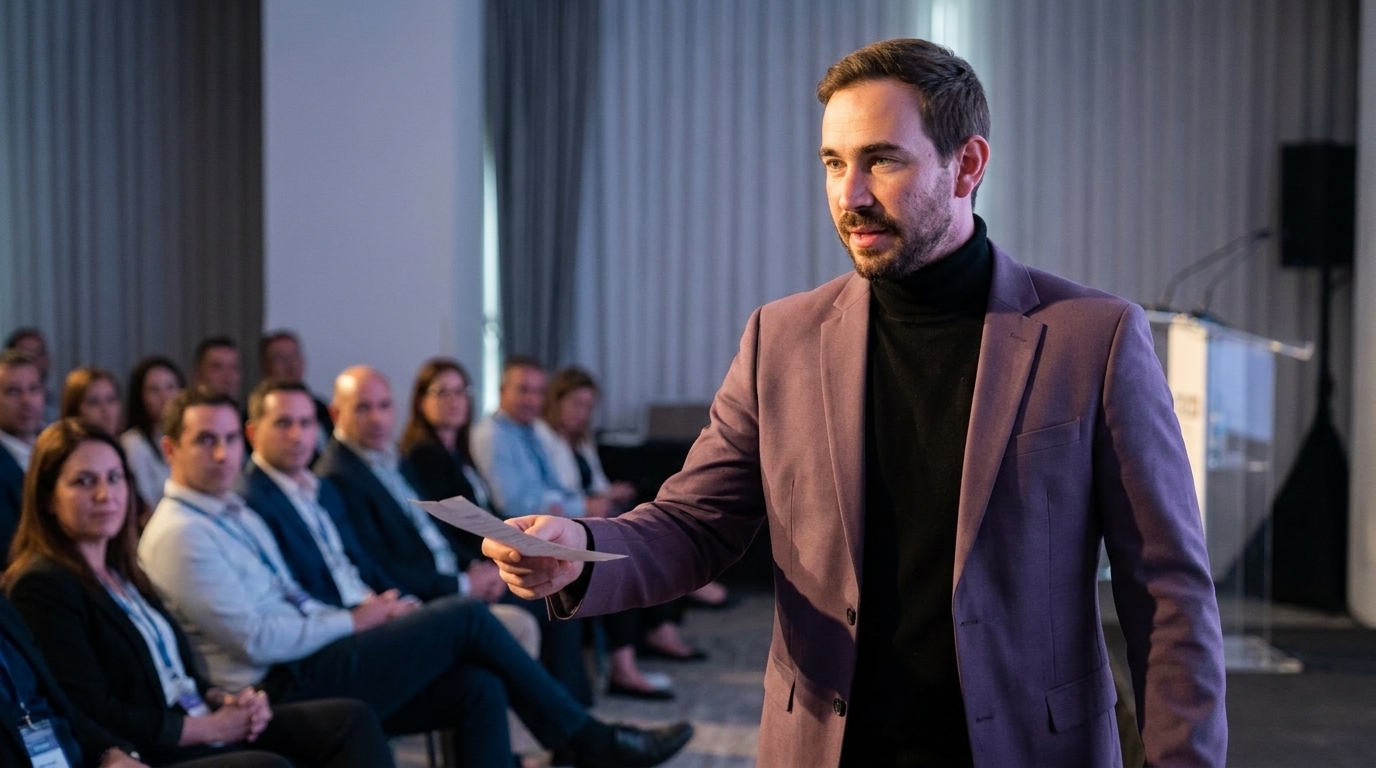
- Featured on Netflix
- Ranked 7th in the world in mentalism
- Shows and keynotes for companies
On this page
- What do I need to send in the first email to book a keynote speaker?
- What moves the price, and why say your range first?
- Should you book direct or go through a speakers bureau?
- How far ahead do companies usually reach out?
- What actually locks the date?
- What am I actually giving the room?
- When should you not put a speaker in that slot?
- What happens between the signature and the stage?
- A short checklist before you send the enquiry
- So what is your next move?
You have a date, a hall, a budget that was approved before anyone decided what the day is actually for, and a line on the run sheet that says "keynote, TBC". Now you have to book a keynote speaker, and you would quite like to do it this week rather than across three weeks of emails that all open with "just circling back on this".
I get those emails. I have also sent the reply that makes them longer, which I am not proud of.
So here is the process from my side, both for planners who already know who they want and for planners still staring at a catalogue. What to put in the first message, what moves the number, what locks a date, what makes it drag, and the cases where the honest answer is that a talk is the wrong thing to put in that slot at all.
What do I need to send in the first email to book a keynote speaker?
Five things. Everything else can wait.
- The date and the city. Not "sometime in Q2". A real date, or two candidates. Travel distance changes the answer more than most people expect.
- The slot. Morning opener, post-lunch, closing session, after dinner. This matters more than the topic. A room that has just eaten is a different animal from a room that has just arrived with coffee.
- Who is in the room. One sentence. Sales team, engineering leadership, mixed partners and customers, the whole company.
- What the day is supposed to change. Even roughly. "We are merging two teams and nobody is saying it out loud" tells me more than any topic title.
- The budget you are working inside. Yes, in the first message. A range is enough.
That is a short email and it gets a real answer, usually with a question or two coming back. The threads that stall are the ones that say "what do you charge for a talk" with nothing attached, because the honest answer is a question, and now we have spent two days arriving where we could have started.
What moves the price, and why say your range first?
Planners hate putting a number in an opening email because they assume the number becomes the price. In practice it becomes a filter, and filters save weeks.
I do not publish a figure, because the figure depends on things that live in your brief rather than in mine. What moves it:
- Which service you are actually buying. The lecture, a stage show, close-up magic around the tables, booth work at an exhibition. Different jobs, different numbers.
- Length and format. My lecture runs as a one-hour Zoom session, a one-hour in-person taste, a two-hour deep dive, or a series of five one-hour sessions with one principle in each. Those are four different asks.
- Personalisation. Choosing research examples and demonstrations for your sector is part of the work. A bespoke build for a single room is a project, and projects are priced as projects.
- Place and date. I work anywhere in Israel and abroad, and distance costs a day on either side that cannot be sold to anyone else.
- Extras. Things like branded cards or Polaroid souvenirs around an event are prepared in advance and carry their own cost.
Ori, my personal manager, builds the quote from those answers. When you send a range on day one, what comes back is either "that works, here is what it includes" or "that does not, and here is what I would suggest instead". Both are useful immediately. Neither is useful on day eleven.
Should you book direct or go through a speakers bureau?
Search for a speaker and most of what you find is a bureau: a catalogue of hundreds of names, sortable by topic, fee band and availability, with an agent handling contracts and travel. That model exists for a good reason.
A bureau earns its cut when you genuinely do not know who you want. You say "leadership, this budget, this city" and get a filtered shortlist back quickly. They absorb the admin too: contracts, invoicing, flight changes, the speaker who cancels a week out. Booking several names across a multi-day conference, one point of contact is worth real money.
Going direct is better when you have a specific person in mind, or when the brief is unusual. You talk to the human who will stand on the stage rather than to someone describing them, so the shaping conversation starts before the contract instead of after it. And the brief stays intact, because nothing has been summarised twice on the way through.
My honest position: if your brief is still the words "something inspiring", a bureau will narrow it faster than I will. There is no shame in using both.
How far ahead do companies usually reach out?
Lumpy rather than tidy. Conferences and year-end events tend to arrive months ahead, because the venue was locked long before the content was. Team evenings and sales kickoffs come in much later, often because the plan was "we'll do something in-house" until somebody read the agenda and found slide decks all the way down.
There is no minimum lead time on my side. Late is not automatically a problem; a free date is a free date. What late costs you is the preparation conversation, and that is the part that makes a talk feel written for your company rather than delivered at it.
If you are choosing between enquiring now with a half-formed brief or next month with a clear one, enquire now and brief later. The date is the scarce thing.
What actually locks the date?
A signed contract, usually with a deposit. Not an enthusiastic call, not "we're ninety-five percent there". A date can be held for a limited time while you decide, and if somebody else asks about the same date I will tell you, because the alternative is that you find out when it is gone.
What goes into the agreement is dull and worth reading: date, venue, the length of the slot, who supplies sound, what happens if the event moves. The clause people skip concerns agenda overrun. Conferences run late. Everybody knows conferences run late. Decide in advance whether a late start means a shorter talk or a pushed slot, because settling that in a corridor while a full hall waits is nobody's best work.
What am I actually giving the room?
I work as a mentalist and I research how attention and belief behave under pressure, which is an odd combination to put on a conference stage. I competed at the FISM World Championship of Magic in Quebec in 2022 in the mentalism category, and I appeared on Netflix in Squid Game: The Challenge, which mostly means people recognise me before they decide whether to trust me.
The lecture is called "להיכנס לקופסא", also known as the W.A.N.D framework, and it is built on five principles: attention, the spotlight that makes whatever you highlight feel important; certainty, the thing people are really searching for when you ask them to agree; wonder, a genuine WOW moment built with magic; story, the narrative people use to justify a choice to themselves, the way advertising does; and belief, what happens when the four work together.
The shape is WOW, HOW, NOW. The room experiences the demonstrations, I explain why they worked (the influence mechanism, not the secret of each trick), and then participants connect it to their own work with a personal workbook of about five stops of questions and techniques. It applies to sales, marketing, management, negotiation, branding and HR.
My view on the ethics, since someone always asks: people influence each other constantly. The moral question is whether the person being influenced is harmed, and whoever picks up the tools owns that choice. I will not promise that your team will make anyone believe anything.
When should you not put a speaker in that slot?
Here is the part that costs me work.
If your slot is a networking break with a stage pointed at it, do not book a talk. People holding a glass in one hand and a plate in the other will not sit through a structured session, and I would be competing with a coffee machine for an hour.
If the real goal is that people enjoy themselves and leave in a good mood after a long day of sessions, entertainment beats a framework. That is a different hire and often a better one. I perform a mentalist show for exactly those evenings, typically around fifty minutes, with a different job and a different shape from the lecture.
If your audience is walking past a stand rather than sitting in rows, almost none of this applies. Exhibition floors have their own physics, which is why a trade show magician works to a completely different brief, and I put the aisle-level version of it in my field notes on getting people to stop at your booth.
And if what the company needs is a difficult internal message delivered honestly, an outside speaker cannot do that for you. I can make a room open and curious. I cannot announce your restructure.
What happens between the signature and the stage?
Before the lecture I send a manager a questionnaire about the organisation, its current challenges and what to emphasise, and I use the answers to adapt the topics, the research examples and the magic. Usually there is a call as well.
I ask who is in the room, what they are tired of hearing, which words are loaded inside your company, and what the person speaking before me is covering so I am not repeating their point back to the audience in a different accent.
On the day I want to see the hall empty before anybody is in it. Sightlines, sound, where the light actually falls. I work in Hebrew and English only, I bring my own equipment, lighting is optional and amplification is recommended; I can supply it if the venue cannot. Most of the trouble I have had on stage was solved by walking in early, and the one time I did not, I learned something about a lectern that I still think about. For why the first few minutes decide the rest, there is what Las Vegas taught me about a room's attention.
A short checklist before you send the enquiry
- Fix the date, the city and the venue, or two candidate dates.
- Decide where the slot sits: opener, post-lunch, closing, after dinner.
- Write one sentence about who is in the room and what the day should change.
- Decide which format you want from a keynote speaker: a Zoom session, an in-person taste, a deep dive, or a series.
- Check the language: Hebrew or English, and flag if clean language or adaptation for a religious audience is needed.
- Confirm who owns amplification, and whether the venue has a PA system at all.
- Have your budget range ready for the conversation with Ori, along with any extras you are considering.
So what is your next move?
Decide one thing before you write to anyone, bureau or speaker: is this slot meant to change how people think, or to make them glad they came? Both are legitimate. They are not the same hire, and a planner who knows which one they want gets a straight answer in a day rather than a week.
Which of the two is your agenda really asking for?
Once you know, send the date, the venue and city, where the slot sits in the agenda, roughly how the group is made up and the budget range you are working inside, through the contact form on the site. Ori will get in touch to work out the details and which of the formats actually fits your day.
Questions people ask
Do you travel outside Israel for a keynote?
Yes. I perform anywhere in Israel and abroad, in Hebrew and English only. Distance does affect the quote, because a flight costs a day on either side of the event that cannot be sold to anyone else. If you are flying me in, send the venue and the date early; the date is the scarce resource, and the brief can be built afterwards.
How long is the lecture, and can it be split up?
It runs in four formats: a one-hour Zoom session, a one-hour in-person taste, a two-hour deep dive, or a series of five one-hour sessions, one principle in each. The series suits teams that want to work the material rather than hear it once. Tell Ori how much of the agenda you can give the slot and he will suggest which fits.
Will you single out or embarrass anyone in the audience?
No. Taking part is voluntary. Only people who want to come up do, a refusal is respected, and I never make a joke at a participant's expense. I pick people fairly randomly and keep the stage happy. Clean language and adaptation for a religious or Haredi audience can be arranged in advance if you tell us when you enquire.
Can you guarantee the talk will raise our sales numbers?
No, and I would be careful with anyone who does. The lecture gives people a working understanding of attention, certainty, wonder, story and belief, plus a workbook of about five stops where they apply it to their own work. What they do with it on Monday is theirs. I will not promise a measured rise in any metric.
What do you need from the venue on the day?
Amplification is recommended and I can supply it if the venue cannot. Lighting is optional, though I prefer to see faces. I bring my own equipment. I also want access to the empty hall before the audience arrives, to check sightlines and sound, which has prevented most of the problems I have ever had on stage.

Who writes here
Neta Bresler, mentalist and perception researcher. Ranked 7th in the world in mentalism, featured on Netflix, performing and speaking for companies and conferences in Israel and abroad. Everything here comes from the stage, not the library.
More about Neta