Motivational Speaker for Corporate Events: WOW, HOW, NOW
A motivational speaker for corporate events changes attention and belief. What the WAND lecture covers, what sets the price, and how to book through Ori.
9 min read
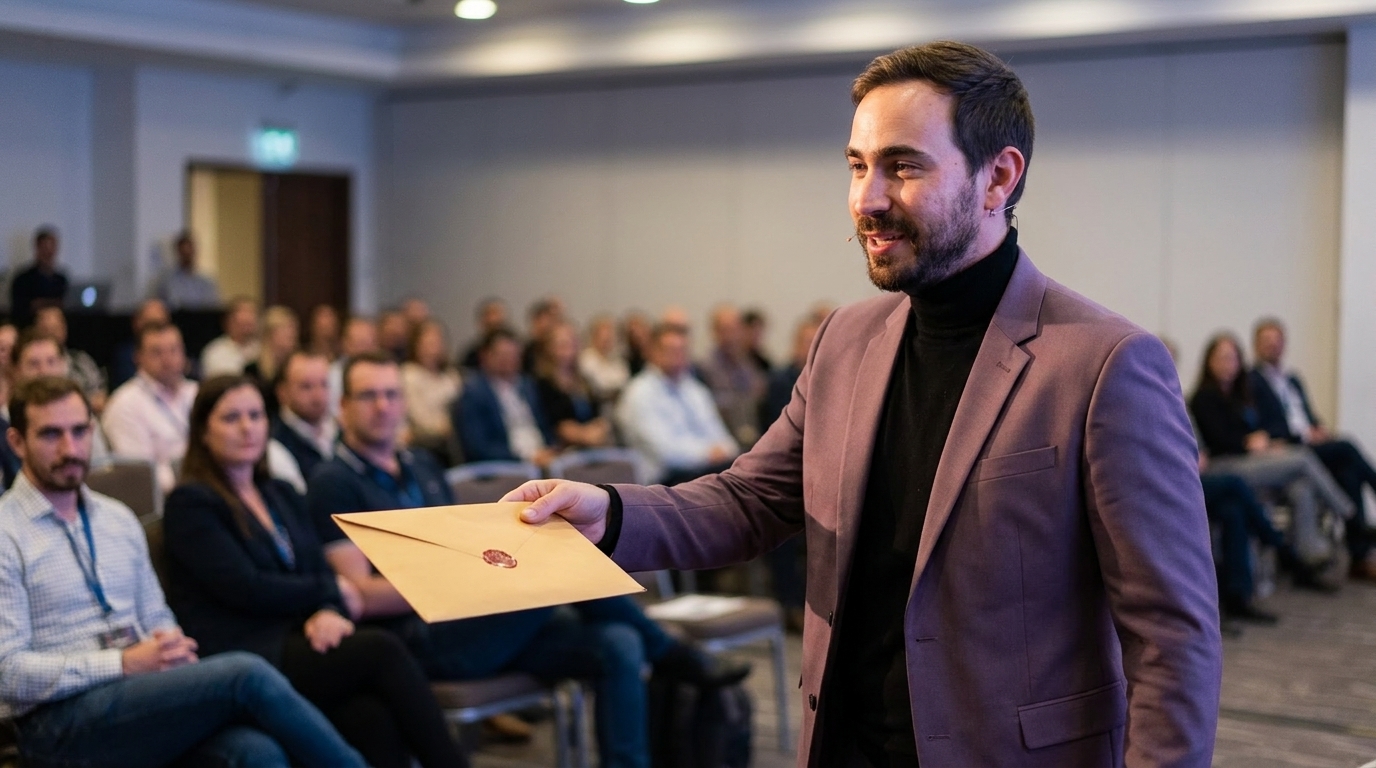
- Featured on Netflix
- Ranked 7th in the world in mentalism
- Shows and keynotes for companies
On this page
- What does a motivational speaker for corporate events actually change in the room?
- What is actually inside the lecture?
- How do I know it will fit our company and not a generic audience?
- Where do I stand on the ethics of teaching influence?
- Is a talk the right purchase, or do we want entertainment?
- Who should not book me for this?
- Does a sceptical audience ruin it?
- What does a talk like this cost?
- What should you check before you send the enquiry?
- So what is the decision in front of you?
Why does booking a motivational speaker for corporate events usually happen last, after the venue, the catering and the AV, and usually with the phrase "something inspiring, something that lifts them"?
Because by then the day already has a shape, and the talk is the only part still soft enough to be described in feelings instead of in content. I get that brief often. A conference, a team evening, a product launch, a year-end gathering, and a slot in the agenda where somebody has to stand up and make the room believe the year ahead is worth the effort.
Most planners start by scrolling a bureau list of names and headshots, which is a fine way to see what exists and a slow way to decide anything. Booking one defined framework directly, from the person who performs it, skips the middle layer and tells you in one conversation whether it fits your room.
So let me be useful rather than flattering. A talk will not fix a compensation problem, a reorg nobody explained, or a manager everyone is quietly waiting out. What it can do is change what people pay attention to, and change what they are willing to believe about their own judgement.
That is a narrower claim. It is also the one I can actually stand behind.
What does a motivational speaker for corporate events actually change in the room?
I work as a mentalist. My day job is being wrong on purpose in front of people and then being right in a way they cannot explain, which sounds like a party trick until you watch what it does to a room. The moment someone's prediction about themselves fails, they get curious about how their own head works.
That curiosity is the material. The applause is a by-product.
My lecture is called להיכנס לקופסא, and in English I call it WAND. One lecture, two names. The subject is practical belief design: how you shape the information people take in, and the belief they build out of it.
The magic demonstrations are there to link physical attention to mental attention, because what attention lands on becomes the information a belief is built from, and words steer where attention lands.
What is actually inside the lecture?
Five principles, in this order.
- Attention. A spotlight. Whatever you highlight gains importance, and whatever you leave in the dark may as well not exist.
- Certainty. People go looking for certainty all the time. Understanding that search is most of the work when you are trying to reach agreement.
- Wonder. A real WOW moment, built with magic, because a demonstrated idea is remembered differently from a described one.
- Story. Narrative and self-justification, the way advertising has used them for a century.
- Belief. The four above combined into one new belief.
The flow is WOW, HOW, NOW. First the room experiences the demonstrations. Then I explain why they worked, meaning the influence mechanism, not the secret of each trick (I am not giving those away, and knowing them would not help anyone in a pricing call). Then participants connect it to their own work, using a personal workbook with about five stops of questions and techniques.
It applies to sales, marketing, management, negotiation, branding and HR. If that sounds like your room, the keynote speaker page lays out the same thing from the planner's side.
How do I know it will fit our company and not a generic audience?
Before the lecture I send a manager a questionnaire about the organisation, what it is dealing with right now, and what you want emphasised. The answers decide which topics get weight, which research examples I use, and which magic goes in.
That is the whole customisation mechanism. No secret sauce, just the boring discipline of asking first.
Formats, so you can slot it: a one-hour session over Zoom, a one-hour in-person taste, a two-hour deep dive, or a series of five one-hour sessions, one principle each. The series is the version where people actually change a habit, in my opinion, because one sitting is enough to move a belief and rarely enough to move a routine.
Where do I stand on the ethics of teaching influence?
I get asked this, and I would rather answer it on the page than in the Q and A.
People influence each other constantly, in every meeting and every ad. The moral question, as I see it, is whether the person being influenced ends up harmed. Whoever picks up these tools owns that choice.
I will not promise that your team will make anyone believe anything, and I will not promise a measured rise in sales, because I cannot see your pipeline and I do not sell numbers I have not verified.
What I can say is that I work with these principles on a stage every day. If the magic does not work, the show does not work. That is a harsher feedback loop than most speaking subjects have.
Is a talk the right purchase, or do we want entertainment?
Sometimes entertainment is the correct answer and I will say so on the call.
If the evening is a dinner and the job is to make the room feel good about being in the same room, you want the stage show, not the lecture. That is a mentalist show, typically around fifty minutes, adjustable by agreement, and it can be personalised with inside jokes, your field, an outstanding employee, a company milestone or a message you want delivered. Taking part is voluntary. Nobody is embarrassed, and a refusal is respected.
If your event is an exhibition rather than a conference, a stage talk is the wrong instrument altogether. Floor work is its own craft, which is why I treat booking a trade show magician as a separate conversation, and why I wrote up how a crowd actually starts at a booth rather than folding it into speaker advice. A brilliant keynote does nothing for an aisle.
Who should not book me for this?
Here is the part that costs me work.
If what you need is a strategy day facilitator, somebody to run breakouts and hand you a document with action items and owners, do not hire me. I can design the hour that makes people think differently for the rest of the day. I will not run your workshop and I will not arrive with a consultant's deck.
If leadership has just announced redundancies and the job of the evening is to make that feel fine, also no. Wonder does not survive a room that is being asked to swallow something. People detect the mismatch early, and the rest of the hour is me performing at a wall.
And if you need English rather than Hebrew, that is fine. Those are the only two languages I work in.
Does a sceptical audience ruin it?
The opposite, in my experience. Analytical rooms lean in, try to catch it, and when the mechanism turns out to be their own attention rather than my hands, the idea lands harder than it would with a soft crowd.
For the record on background, since planners ask: I competed at the FISM World Championship of Magic in Quebec in 2022 in the mentalism category, and I appeared on Netflix in Squid Game: The Challenge.
If you want the longer argument about why attention is the real constraint on a conference stage, I made it in a piece about speaking in Las Vegas and the attention problem.
What does a talk like this cost?
I do not publish figures, and you should be suspicious of anyone who publishes one before hearing the brief.
The price depends on which service you want, its length and format, how much personalisation goes in, any extras, the place and the date. The path is simple: an enquiry through the site, a conversation with Ori, my personal manager, who works out the details and which product actually fits, then a quote and a contract, usually a deposit, then the event.
There is no minimum lead time. Booking early mainly protects the date from being taken by someone else, and a date is held for a limited window until the contract is signed.
What should you check before you send the enquiry?
- Decide whether the slot needs a lecture, a stage show, or both on different dates. They are separate purchases.
- Pick the format you can defend in the agenda: a Zoom hour, an in-person taste, a deep dive, or the five-session series.
- Nominate the manager who will fill in the pre-lecture questionnaire, and give them time to answer it properly.
- Write down the one challenge the organisation is sitting on right now, in a sentence. That sentence shapes the content more than anything else you send.
- Confirm amplification. I recommend it for any room beyond a small one, and I can supply it.
- Flag early if the audience needs clean language or adaptation for a religious or Haredi crowd, and whether the session runs in Hebrew or English.
So what is the decision in front of you?
Decide what you want a person in the fourth row to be able to say to a colleague the following week. If the honest answer is "that it was fun", book entertainment and enjoy the evening with a clear conscience. If the answer is a sentence about how people decide, how attention gets spent and how belief gets built, then the lecture is the right instrument.
Which of those two is your event really asking for?
When you know, send the date, the city or venue, roughly how many guests you expect, and what comes immediately before and after the slot. The contact form on the lectures page and the WhatsApp number there both reach Ori, and you will get a straight answer about whether this fits your room or whether you want a different kind of speaker entirely.
Questions people ask
Is the lecture the same thing as the mentalist stage show?
No. They are separate purchases with separate briefs. The stage show is entertainment, typically around fifty minutes and adjustable by agreement, suited to ages ten and up. The lecture is content: five principles of belief design with a personal workbook of about five stops. Some companies book one at a team evening and the other at a conference, on different dates.
Can you deliver it in English for an international team?
Yes. I work in Hebrew and English only, in Israel and abroad. If your audience is mixed, tell Ori which language the majority thinks in, because the demonstrations depend on wording and the explanation section depends on nuance. A translated-on-the-fly version is not something I offer, so pick one language per session.
What do you need from us before the date?
A manager who answers the questionnaire about the organisation, its current challenges and what you want emphasised. That is what shapes the topics, examples and magic. Beyond that: confirmation of language, whether clean language or adaptation for a religious or Haredi audience is needed, and amplification, which I recommend for anything beyond a small room and can supply.
Will this increase our sales numbers?
I will not promise that, and I would be cautious with anyone who does. I cannot see your pipeline and I do not publish numbers I have not verified. What the lecture gives people is a working understanding of how attention becomes information and information becomes belief, applied to sales, marketing, management, negotiation, branding or HR, plus a workbook to translate it into their own role.
How does booking actually work?
You send an enquiry through the site with the date, the place and roughly how many guests. Ori, my personal manager, calls to work out the details and which product actually fits. Then a quote, a contract, usually a deposit, then the event. There is no minimum lead time, though booking early keeps the date from being taken while the contract is being signed.

Who writes here
Neta Bresler, mentalist and perception researcher. Ranked 7th in the world in mentalism, featured on Netflix, performing and speaking for companies and conferences in Israel and abroad. Everything here comes from the stage, not the library.
More about Neta