After Dinner Speaker: Winning a Fed Room
An after dinner speaker faces a warm, loud, well-fed room. What that slot demands, what the price depends on, and how to brief the evening so it lands.
9 min read
- Featured on Netflix
- Ranked 7th in the world in mentalism
- Shows and keynotes for companies
On this page
- Why does the after dinner slot feel so different from a morning talk?
- Should I book an after dinner speaker or just entertainment?
- What makes a mentalist a reasonable choice for this slot?
- How much does an after dinner speaker cost?
- What should I tell you before the night?
- When should you not book me?
- How do I know afterwards whether it worked?
- A short checklist before you book
- The next step
Have you ever watched a perfectly good speaker die quietly over coffee?
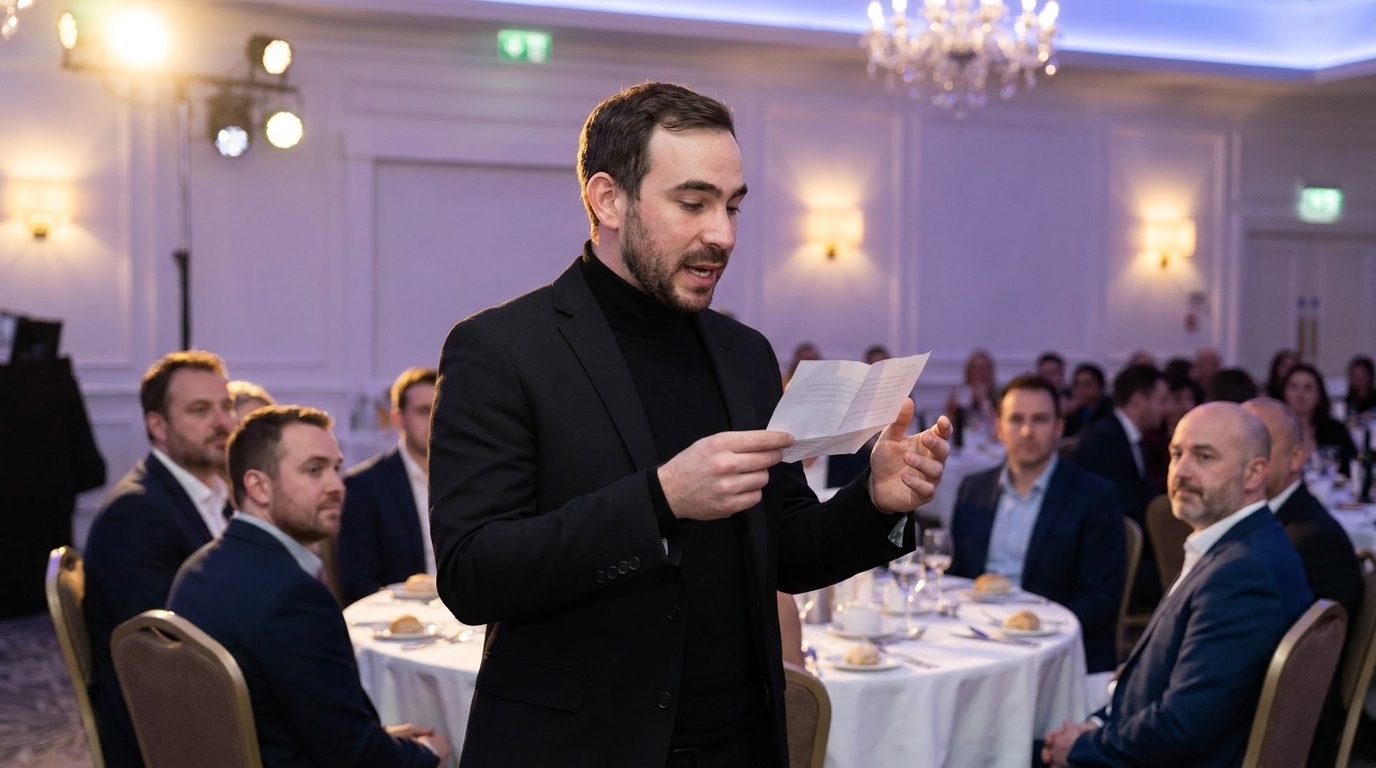
The slot looks harmless on the run sheet. Dinner, dessert, speaker, dancing. By the time the after dinner speaker steps up, the room has eaten, had a drink, told the same three stories at every table and decided, collectively and without a vote, that the serious part of the evening is finished. Somebody at the far table is laughing at something that has nothing to do with your company. The waiters are clearing. There is a door at the back and everyone now knows exactly where it is.
That is the room. Not a hostile one. A full, warm, slightly loud one that is no longer in the mood to be taught anything.
I work that slot at company events often, and I would rather be honest about what it asks for, because it is a different sport from a morning keynote in a similar looking uniform.
Why does the after dinner slot feel so different from a morning talk?
In the morning, attention is yours by default. People arrived in order to listen. They have not been fed, they have not relaxed, and they are still performing "professional" for each other.
After dinner, attention has to be re-earned every few sentences. Blood sugar is up, inhibition is down, the social temperature of the room is high. That is material, not an obstacle.
What breaks in that slot is almost always the same thing: a talk built for silence, delivered into a room that has already decided to be social. Slides with small text. A three-part model that needs sustained concentration. A story that takes a long walk to reach its point. All of that would land fine at nine in the morning.
So the content changes shape. It does not get dumber. It gets more load-bearing per sentence.
Should I book an after dinner speaker or just entertainment?
Fair question, and the words are worth sorting out, because three different people get called in for the same slot.
- A speaker talks from somewhere real: a field, a practice, a point of view, a demonstration. The audience is meant to leave carrying something, even if they laughed most of the way through.
- A comedian is there for the laugh itself, which is a complete and respectable job. The set is written material, tested elsewhere, and it usually does not bend to your quarter or your merger.
- A host serves the running order. They keep the evening moving, cover the walk from a far table to the stage, protect the CEO from an open microphone, and leave almost no trace of themselves.
Which one you need comes from what the dinner is for. If the evening is a reward, a thank you, the release valve at the end of a conference, do not book a talk. People have absorbed enough content for one week. A mentalist show fits that evening better than a lecture does, and mine runs typically about fifty minutes, shorter or longer by agreement.
If the dinner is the one evening the whole company sits in the same room all year, and leadership genuinely wants everyone to carry something home, a speaker makes sense. The speaking just has to be built for the hour it is in.
The failure I see most is the hybrid nobody briefed: a conference talk with two jokes bolted on the front, dropped into a dinner. The content gets heard as entertainment and the entertainment is too thin to carry an evening.
What makes a mentalist a reasonable choice for this slot?
Here is the structural advantage, stated plainly. A talk asks people to follow. A demonstration makes them react.
When something apparently impossible happens to a guest at one table, the whole room turns. Not out of politeness. A reflex fires, and that reflex is older than your agenda. Once the room has turned, there is a window of undivided attention in which something can be said that matters.
My lecture, להיכנס לקופסא (also called WAND), is built on that rhythm: attention, certainty, wonder, story, belief. Five principles about how a person goes from noticing something to believing it. The demonstrations are the evidence, not the decoration, and the explanation afterwards is about the mechanism of influence rather than the secret of any one trick. I have written separately about the attention problem in a loud room, and most of it applies here with the volume turned up.
If what you want is the thinking version rather than the show, that work lives on the keynote speaker page, in formats from a one hour taste to a two hour deep dive, or a series of five sessions, one principle at a time.
How much does an after dinner speaker cost?
Everybody reads this section first, so here is the honest answer: I do not publish a figure, and I am not going to invent one for the market either.
What the price for my own work depends on is specific and easy to list. Which service you want, a show or a lecture or close-up magic between the tables. How long it runs and in what format. How much personalisation goes into it. Any extras prepared in advance, such as Polaroid souvenirs or custom cards at a close-up evening. The place. And the date, which matters more than people expect, because every company in the country holds its year-end dinner inside the same few weeks.
The path is short. An enquiry through the site, then a conversation with Ori, my personal manager, who works out the details and which product actually fits your evening, then a quote and a contract, usually with a deposit. A date can be held for a limited time until the contract is signed.
What should I tell you before the night?
Three things matter more than the brief itself.
What the dinner is for. A thank you evening, a conference closer, a launch, a company milestone. The answer changes the whole act.
What happens immediately before and after. If an emotional awards section just ran long, the room is in a different state than if it has just finished the main course. If the dance floor opens straight after me, everyone in the room already knows it.
What leadership is not saying out loud. A rough quarter, a restructure, an announcement that has not been made. I will not mention it. I will say different things if I know.
On the practical side I take care of my own equipment. Lighting is optional. Amplification is recommended, and I can supply it if the venue cannot. Personalisation can include inside jokes, the company's field, honouring outstanding employees, marking a milestone, or carrying one specific message the company wants delivered.
When should you not book me?
Let me cost myself something.
Do not book me for a dinner where the room does not share a language with me. I perform in Hebrew and English only, and my material depends on precise instructions landing precisely. If half the room is translating in their heads, the demonstrations still work and the meaning does not.
Do not book me for a late slot that follows drinks with no food. I have done it. It is survivable and it is not good work. Wonder needs a baseline of attention to push against.
And do not book me as a surprise. Tell the room a mentalist is coming. The anticipation is free and it works in your favour.
One more thing people ask about and deserve a straight answer on: nobody is dragged up. Taking part is voluntary, I choose people fairly randomly, a refusal is respected, and nothing in the show happens at a guest's expense. Clean language and adaptation for a religious or Haredi audience can be arranged in advance.
How do I know afterwards whether it worked?
Not from the applause. Applause after dinner is generous and means very little.
Look for the thing people repeat. If the next morning several people describe the same moment to a colleague who was not there, the idea attached to that moment travelled with it. (This is also why I listen to the coffee queue more carefully than to the room while I am on.)
If an evening wants wonder spread across the tables rather than from a stage, close-up magic is the other option: table to table, roughly five to ten minutes each, which by my own estimate reaches somewhere between fifty and a hundred and twenty guests an hour. An estimate, never a promise to reach everyone.
A short checklist before you book
- Write one sentence saying what this dinner is for, and show it to whoever signs the budget.
- Decide whether you want a stage show, a lecture, or close-up magic between the tables before the speeches.
- Check the language of the room: Hebrew or English, comfortably, for everyone in it.
- Confirm who is providing amplification, and whether the venue has anything beyond background music sound.
- List the personalisation you want: inside jokes, the company's field, an employee to honour, a milestone, one message to carry.
- Flag anything sensitive happening in the company that week, even if it stays unmentioned on stage.
- For a lecture, expect a questionnaire from me about the organisation and its current challenges, and answer it properly.
The next step
Send the date, the place and the number of guests through the contact form or the WhatsApp link on the shows page, and Ori will come back to you with what fits and what it depends on. If you are still unsure which half of that evening you are buying, say so in the message. That conversation is usually shorter than the email loop that replaces it.
So, before you call anyone: what is your dinner actually for?
Questions people ask
Can the talk or show be adapted to our company?
Yes. Personalisation can include inside jokes, the company's field, honouring outstanding employees, marking a company milestone, or carrying one specific message you want delivered. For the lecture there is a questionnaire beforehand about the organisation and its current challenges, and the topics, examples and magic are adapted from your answers. The more honest the answers, the better the fit.
What happens if the dinner runs late and our slot shrinks?
Tell me as early as you can on the night. The stage show is typically about fifty minutes and can be adjusted shorter or longer by agreement, so a shortened slot is workable if it is agreed rather than discovered at the microphone. What does not work is cutting the opening, because that is where the room decides to pay attention at all.
Do you need a stage, lighting and sound?
I take care of my own equipment. Lighting is optional. Amplification is recommended, especially in a dining room where the sound system was designed for background music, and I can supply it if the venue cannot. Beyond that I need a comfortable place to work from where the far tables can see, which is a conversation with your venue rather than a fixed requirement.
Will anyone be embarrassed in front of their colleagues?
No. Only people who want to come up do, I choose them fairly randomly, and a refusal is respected without comment. Nothing in the show happens at a guest's expense. Clean language and adaptation for a religious or Haredi audience can be arranged in advance. The show suits ages ten and up and is best for teenagers and adults.
How far in advance should we book?
There is no minimum lead time, but booking early is the only way to keep a popular date from being taken, and year-end dinners cluster into a few weeks. The path is an enquiry through the site, a conversation with Ori, my personal manager, then a quote and a contract, usually with a deposit. A date is held for a limited time until that contract is signed.

Who writes here
Neta Bresler, mentalist and perception researcher. Ranked 7th in the world in mentalism, featured on Netflix, performing and speaking for companies and conferences in Israel and abroad. Everything here comes from the stage, not the library.
More about Neta