How to Choose a Keynote Speaker: Start With the Room
How to choose a keynote speaker for a conference or team evening: the filters that cut a long shortlist down to the two names worth a call.
10 min read
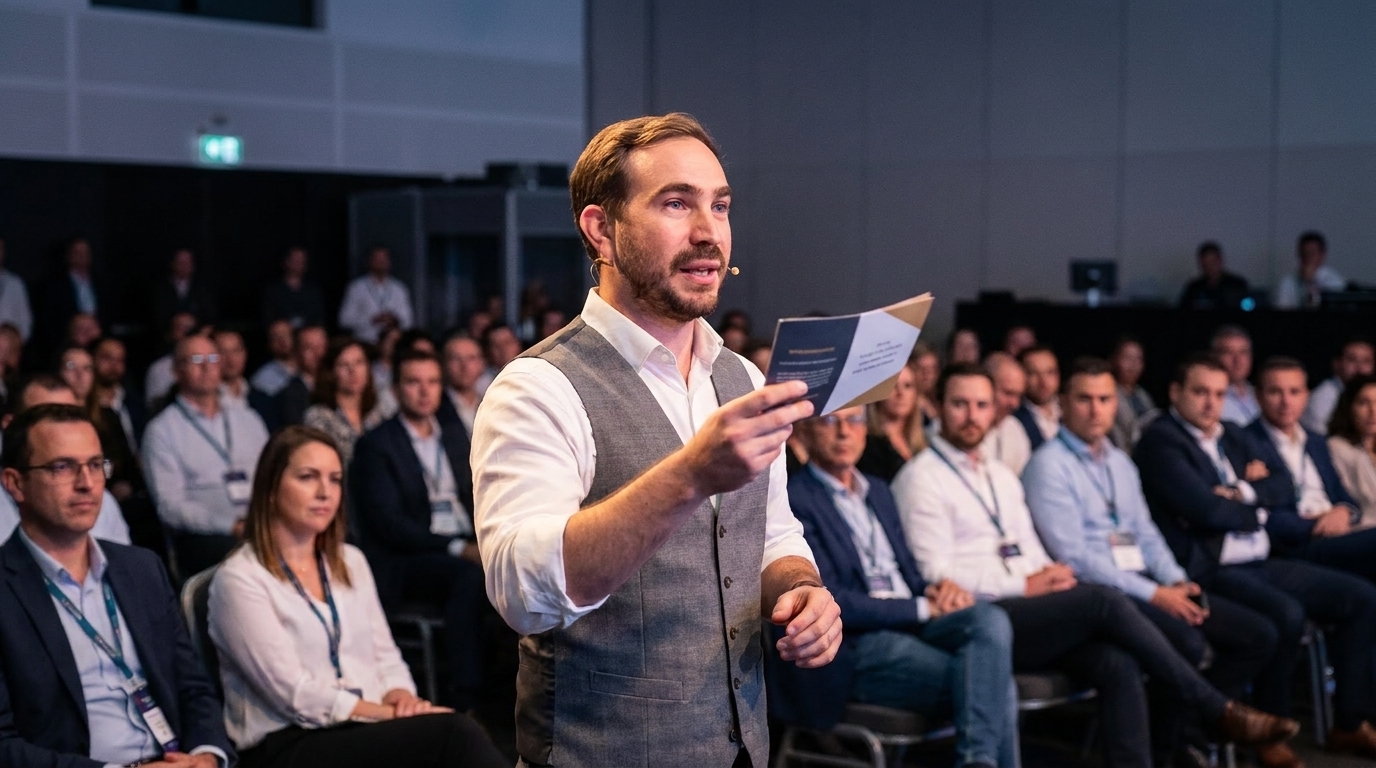
- Featured on Netflix
- Ranked 7th in the world in mentalism
- Shows and keynotes for companies
On this page
- Who is actually in the room, and what is the event for?
- What should I look at before anything else?
- How do I tell showmanship from substance?
- Should the speaker know my industry?
- What questions actually separate the shortlist?
- When is the answer to hire somebody else?
- How much weight should I give the price?
- What to check before you book
- So what do you do with the shortlist now?
You have a shortlist, don't you? Four names, maybe seven, pulled from a colleague's recommendation, an agency deck and one video that somebody's manager liked. Every one of them looks confident on stage. Every one of them has a reel with applause in it. And you are supposed to pick the one who will stand in front of your people, on your date, and justify the slot.
So let me put it plainly. How to choose a keynote speaker is not really a question about who is good. Most people on a shortlist are good at speaking. It is a question about which kind of good matches what your room actually needs on that day, at that hour, after whatever came before it.
Here are the filters I use when a client asks me to help them judge a list. Including, sometimes, a list I am on.
Who is actually in the room, and what is the event for?
Before the slot, before the budget, before anybody's reel: write down who is sitting there.
Not "our employees". Roles and seniority. A hall of field sales people who travelled in that morning is a different animal from a management forum of twenty people who have all read the same business books. A mixed company evening where developers, finance and operations sit at the same tables is a third thing again, and it punishes any talk built for one of those groups only.
Then write the objective in one sentence. Not a theme. An objective. "We are merging two departments and we need them to stop treating each other as rivals." "We want the sales team to walk out with a different way of handling the moment a client hesitates." "We closed a hard year and the evening has to feel like a reward, not a lecture about resilience."
Those two lines do more sorting than any criteria list. Half the shortlist usually falls away once you have written them, because you can finally see that three of the names were chosen for how they present rather than for what they are supposed to change.
What should I look at before anything else?
After the audience and the objective, the slot. Always the slot.
A speaker who is magnificent first thing in the morning, when the coffee is fresh and nobody has opened a laptop yet, can die slowly in the graveyard shift after lunch. The after-dinner slot is different again: the wine is out, the tables are loud, and the content has to survive interruption rather than depend on silence.
So before you compare names, write down three more things on one line: when the talk happens, what happens immediately before it, and what the audience has been doing all day. Then ask each candidate how that changes their material.
The honest ones will have an answer. The ones who say "my talk works everywhere" are telling you they have one talk. I wrote more about what a hall does to attention when the day has already been long in a piece on the attention problem a keynote speaker faces in Las Vegas, and the physics of it are the same in Tel Aviv, Berlin or a hotel ballroom outside London.
How do I tell showmanship from substance?
You usually can't from a reel. A reel is edited by somebody who wants you to book the person, and the applause is real but the context is gone.
So change the test. Ask for the argument, not the highlights. One sentence: what does this talk want the audience to believe at the end that they did not believe at the start?
If the answer comes back as a list of themes (innovation, resilience, change) you have someone selling a mood. A mood is not nothing. But a mood evaporates somewhere on the drive home. If the answer is a claim, something a reasonable person could argue with, you have someone who has done the harder work of deciding what they think.
My own lecture, which goes by two names, "להיכנס לקופסא" and WAND, is built on five principles: attention, certainty, wonder, story and belief. Attention is a spotlight, and whatever it lands on gains importance. Certainty is what people are quietly searching for, and understanding that search changes how you ask for agreement. Wonder is a genuine gap between what people expected and what happened. Story is how they justify it to themselves afterwards. Belief is what the other four combine to build.
When a planner asks me how to evaluate a keynote speaker, I suggest running any candidate through those five, because a talk can be strong on three of them and still leave the room with nothing to carry out of it.
Should the speaker know my industry?
Less than you think, and more than they will admit.
Deep sector knowledge sometimes works against the talk. A speaker who knows your market intimately will tell your people what they already know, in the language they already use, and the room will nod politely at its own reflection. Part of the value of an outside voice is precisely that it comes from outside.
What they do need is specific knowledge of your situation. Not the industry. The situation. Are you merging two teams that do not like each other? Launching something the market has not asked for yet? Closing a year that went badly and nobody wants to say so out loud?
A speaker who takes the brief by email and never asks a follow-up question is going to deliver the standard version. In my case the follow-up is a questionnaire I send to a manager before the lecture: what the organisation does, what it is struggling with right now, what to emphasise. The answers decide which principles get the most time, which research examples I use and which demonstrations go in.
What questions actually separate the shortlist?
Four, and they take one call each.
- What goes wrong in this talk? Everyone has a failure mode, and a speaker who claims nothing ever goes wrong has either not worked enough rooms or is not being straight with you.
- What do you need from the room? Sightlines, amplification, a microphone that leaves both hands free. If a speaker has no technical requirements at all, they have not thought about the space.
- What happens in the opening? Not the whole talk. The first minute or two, where the room decides whether to listen or check their phones. Anyone serious has an answer ready.
- What would make you turn this booking down? My favourite, because it shows whether the person has standards or a calendar to fill.
When is the answer to hire somebody else?
Reasonably often, in my case, and I would rather say it here than in a frustrated email two weeks before the date.
If your people need a technical deep dive, a regulatory update or a methodology they will be tested on, I am the wrong booking. My work lives in perception, attention and belief. I can change how a room thinks about certainty and evidence. I cannot teach them your compliance process. Bring the specialist in for that and put me somewhere else on the agenda.
If what you actually need is atmosphere rather than argument, that is also a different hire. Sometimes the honest brief is "make the evening feel good and give people something to talk about afterwards", and in that case a mentalist show does that job better than any talk would. And if the real goal is traffic at an exhibition stand, that is a third thing with its own logic, closer to what a trade show magician does; I put the mechanics of it into my field notes on getting people to stop at your booth.
Being clear about which of the three you need removes most of a shortlist before you make a single call.
How much weight should I give the price?
Enough to stay inside your budget, not enough to decide the booking.
A fee moves with the service itself, its length and format, how much the content is adapted to your organisation, any extras, the place and the date. A talk researched around your situation costs more than one pulled off the shelf, because somebody spent days on it that you will never see. That is normal, and it is also why the cheapest quote on a list of five is often the one that will feel most generic on the day.
What should worry you is not a high number. It is a number given before anyone asked you a single question about your event. If somebody can price the work without knowing the audience, the slot or the situation, they are pricing a product rather than a talk. (On my side, the quote comes after a conversation with Ori, my personal manager, for exactly that reason.)
What to check before you book
- Write the audience in roles and seniority, and the objective of the event in one sentence.
- Decide whether the job is an argument, an atmosphere or traffic at a stand, because they are three different hires.
- Note the slot, what precedes it and what the room has been doing all day, and ask each candidate how that changes their material.
- Ask what format fits: a short in-person taste, a longer deep dive, a Zoom session or a series of sessions spread over time.
- Check the preparation process. Is there a questionnaire or a call before the date, or does the brief travel by email only?
- Confirm amplification and sightlines with the venue, and the language the talk will be delivered in (I work in Hebrew and English).
- Hold the date early. A date can be reserved for a limited time, and it stays open only until the contract is signed.
So what do you do with the shortlist now?
Cut it to two. Not one, because availability is real and your date may already be gone. Two names, each of whom asked you something about your event that you had not thought of yourself.
Then ask the uncomfortable question: if this talk works exactly as intended, what will be different in the building on Monday morning? If you cannot answer that, the problem is not the shortlist. It is the brief, and no speaker can repair a brief from the stage.
For what it is worth, my own credentials are checkable rather than atmospheric: I competed in the mentalism category at the FISM World Championship of Magic in Quebec in 2022, and I appeared on Netflix in Squid Game: The Challenge. Neither of those tells you whether I fit your room. Only the call does.
When you are ready to test a name against your actual event, send the date, the city or venue, roughly how many people will be in the room and which slot the talk sits in, through the contact form on the lectures page. Ori will come back to you, work through the details and tell you honestly whether this is the right fit, or who you should be calling instead.
Questions people ask
How far in advance should I book a keynote speaker?
There is no minimum lead time on my side, but popular dates go first, especially around year-end events and conference season. Booking early is mainly about protecting the date: once we agree, it is held for a limited period until the contract is signed, and a deposit usually follows. If your date is fixed, start the conversation as soon as the slot exists on the agenda.
What formats can a lecture take if a full keynote slot is not available?
My lecture runs as a one-hour session on Zoom, a one-hour in-person taste, a two-hour deep dive, or a series of five one-hour sessions with one principle in each. The format changes how much the audience gets to apply the material; the shorter versions concentrate on demonstration and explanation, while the longer ones leave room for people to connect it to their own work.
Can a keynote speaker also entertain at the evening event?
They are separate bookings with separate logic. A lecture is built around an argument and the audience's own work; a stage show is built to entertain, typically running about fifty minutes and adjustable by agreement, suited to ages ten and up. Some companies book a talk in the daytime programme and a show after dinner, but each one is briefed and prepared on its own.
How do I know the speaker will not embarrass my employees?
Ask directly how audience participation works. On my stage, taking part is voluntary: only people who want to come up do, a refusal is respected, and nobody is the butt of the joke. If the audience includes religious or Haredi guests, clean language and other adaptations can be arranged in advance. Any speaker who cannot describe their participation rules has not thought about your people.
What does the price of a keynote speaker depend on?
The service itself, its length and format, how much it is adapted to your organisation, any extras, the place and the date. I do not publish figures or ranges, because a number given before anyone has asked about your audience and slot is a guess. Send your event details through the contact form and Ori, my personal manager, will build a quote around the actual brief.

Who writes here
Neta Bresler, mentalist and perception researcher. Ranked 7th in the world in mentalism, featured on Netflix, performing and speaking for companies and conferences in Israel and abroad. Everything here comes from the stage, not the library.
More about Neta