Corporate Speaker: Why I Open With a Trick
A corporate speaker who performs mentalism every day on what attention, certainty, wonder, story and belief look like inside a company lecture.
7 min read
- Featured on Netflix
- Ranked 7th in the world in mentalism
- Shows and keynotes for companies
On this page
- What does a corporate speaker like you actually talk about?
- Why open with magic instead of slides?
- How do you make it about our company and not a generic talk?
- What formats does the lecture come in?
- Where this goes wrong, and when not to hire me
- Is the audience going to get embarrassed?
- What about the ethics of teaching influence?
- A little context on the attention problem
- What to check before you book
Who in that room actually wants you there?
If you are booking a corporate speaker for a conference, a leadership day or a team evening, you already know the honest answer. Some people want the content. Some want the coffee break. A few are there because their manager said so, and they have a laptop open at an angle that says so too. Nobody in that room agreed to be persuaded.
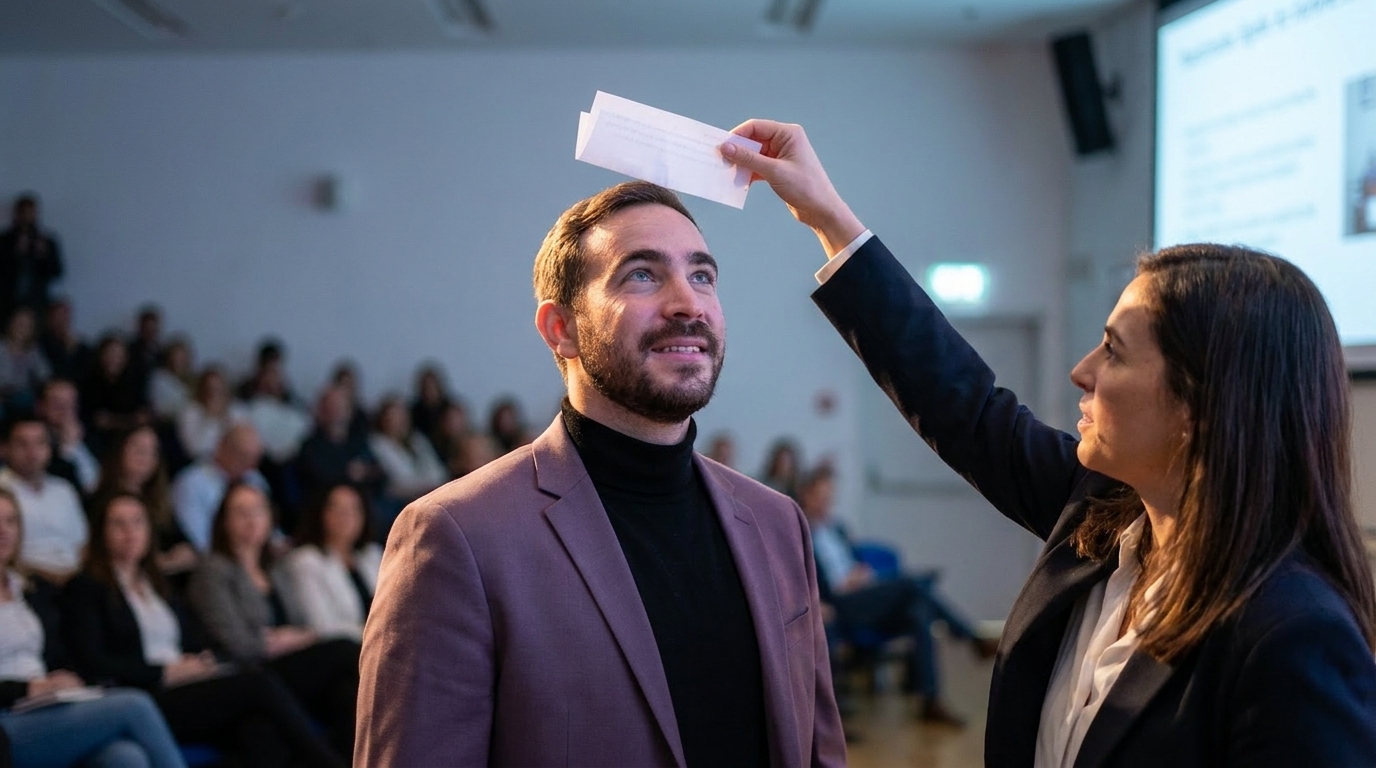
That is the room I walk into. I am a mentalist. I compete, I perform, and I teach a lecture called "להיכנס לקופסא", also known as WAND, about how people build belief out of whatever information lands in front of them. And I open with a trick, every time, for a reason I will explain in a minute.
What does a corporate speaker like you actually talk about?
Belief design. Practical, not philosophical.
Here is the chain I work with. Physical attention and mental attention are linked. Whatever your attention lands on becomes the information you build a belief from. And words steer attention far more than most people are comfortable admitting.
So the lecture walks through five principles:
- Attention as a spotlight: whatever you highlight gains importance, simply by being highlighted.
- Certainty: people are hunting for it constantly, and understanding that hunt changes how you ask for agreement.
- Wonder: a real WOW moment, built with magic, because a room that has felt something listens differently afterwards.
- Story: narrative and self-justification, the way advertising has used them for a century.
- Belief: the four above, combined, to build something new in someone's head.
Sales, marketing, management, negotiation, branding, HR. Those are the places people take it afterwards.
Why open with magic instead of slides?
Because an argument you have heard before is easy to resist, and an experience you just had is not.
The structure is WOW, HOW, NOW. First the demonstrations happen to the audience, live, with them. Then I take them apart: not the secret of each trick (that part is mine), but the influence mechanism underneath it, which is the part that transfers to their Monday. Then NOW, where they connect it to their own work, with a personal workbook of about five stops of questions and techniques.
I have a slightly unfair advantage here, and I say that with full awareness of how it sounds. I use these principles on stage every single day. If the attention work fails, the trick fails in front of everybody. There is no theory to hide behind.
How do you make it about our company and not a generic talk?
Before the session I send a manager a questionnaire. What the organisation does, what it is wrestling with right now, what you want emphasised. That questionnaire is the whole personalisation engine: it shapes which principles get weight, which research examples I use, and which demonstrations go in.
It takes someone on your side maybe one coffee to fill in. It is the difference between a talk that lands on your team and a talk that could have been given to a bank, a biotech firm and a logistics company in the same week.
(If nobody has time to answer it, tell me early. I would rather know than guess.)
What formats does the lecture come in?
Four, and they are genuinely different animals:
- A one-hour session over Zoom.
- A one-hour in-person "taste", which is what most conference agendas have room for.
- A two-hour deep dive, where the NOW part gets real breathing space.
- A series of five one-hour sessions, one principle per session, for teams that want it to stick rather than sparkle.
The series is the one I would push you toward if the goal is behaviour change inside a sales or management team. The one-hour taste is the one that fits a packed agenda, and it is honest about what it is: a strong hour, not a training programme. When you brief a keynote speaker, the format you pick decides more than the topic does.
Where this goes wrong, and when not to hire me
Here is the part that costs me bookings.
If what you need is pure entertainment at a year-end evening, do not book the lecture. Book the mentalist show instead and let people enjoy their night without a workbook on the table. Mixing them helps nobody. I have seen organisers try to buy one thing and expect both, and the lecture always loses that fight.
If you need a certified trainer to deliver a measured increase in quarterly sales, I am not your hire either. I will not promise that, and I would be suspicious of anyone who does. What I can show is the mechanism, demonstrate it live, and hand your people a language for it. What they do with that language on Tuesday is theirs.
And if your conference runs in a language other than Hebrew or English, I cannot help. Those are the two I work in.
Is the audience going to get embarrassed?
No. Participation is voluntary, always. People come up because they want to, a refusal is respected without comment, and I do not build laughs at anyone's expense. A manager who feels exposed in front of their team stops listening, which would defeat the entire point of a lecture about attention.
Clean language throughout, and adaptation for religious or Haredi audiences can be arranged in advance.
What about the ethics of teaching influence?
I get asked this, and I think it is the right question.
My view: people influence each other constantly, in every meeting, every pitch, every performance review. The question worth asking is not whether influence is happening. It is whether the person being influenced ends up harmed. Whoever picks up these tools owns that choice, and I say so out loud in the room rather than leaving it hanging.
I also never claim mind reading, mind control or anything supernatural. It is craft. The craft is more interesting than the myth.
A little context on the attention problem
Rooms have got harder. Phones, back-to-back agendas, a crowd that has already sat through three speakers before lunch. I wrote about this in more detail in a piece on the attention problem on big conference stages, and the short version is that you cannot demand attention from a tired room. You have to give it a reason.
Wonder is a reason. It is also, conveniently, the subject.
What to check before you book
- Decide the job: a lecture that teaches, or an evening act that entertains. Do not ask one to do both.
- Pick the format honestly: Zoom hour, in-person taste, two-hour deep dive, or the five-session series.
- Find the person who will fill in the pre-lecture questionnaire, and check they have the time.
- Name the one challenge you want emphasised, in a sentence a manager would actually say.
- Confirm the language, Hebrew or English, and flag any need for adaptation for a religious audience.
- Sort amplification with the venue; it is recommended for any room beyond a small one.
- Book the date earlier than feels necessary, because a date is only held for a limited time until the contract is signed.
Which of those seven do you not have an answer for yet? Start there.
When you are ready, send the date, the place, how many people are expected and which format you are leaning toward, through the contact form or WhatsApp on the lectures page. Ori, my personal manager, will take it from there and work out the right fit with you.
Questions people ask
Do participants get anything to take away?
Yes. Each participant works with a personal workbook of about five stops of questions and techniques during the NOW part of the session. It is where they connect the five principles to their own role, whether that is sales, management, negotiation, branding or HR. The two-hour deep dive and the five-session series give that part noticeably more room than the one-hour taste.
Do you explain how the tricks are done?
I explain the influence mechanism, not the method of each trick. The HOW section takes apart why your attention went where it went and how the words around the demonstration steered it. That is the part that transfers to a sales call or a board presentation. The secrets themselves stay secrets, which is also a professional obligation I take seriously.
Can you deliver this outside Israel?
Yes, I work anywhere in Israel and abroad, in Hebrew and English only. For an international conference, the practical questions are travel, the slot you have in the agenda and which format fits it. Those details get worked out with Ori, my personal manager, after your enquiry comes through the website, before any quote is issued.
What does it cost?
I do not publish figures, because the number genuinely moves. It depends on the service, the format and length you pick, how much personalisation goes in, any extras, the place and the date. The route is an enquiry through the site, a conversation with Ori to work out the right fit, then a quote and contract, usually with a deposit.
How far ahead should we book?
There is no minimum lead time, so a late enquiry is still worth sending. The real constraint is that popular dates go, and once a date is agreed it is held for a limited time until the contract is signed. If your conference date is already fixed, the sensible move is to send it now rather than wait until the agenda is final.

Who writes here
Neta Bresler, mentalist and perception researcher. Ranked 7th in the world in mentalism, featured on Netflix, performing and speaking for companies and conferences in Israel and abroad. Everything here comes from the stage, not the library.
More about Neta